

 Kyler Chittick
Four words from Ruth DyckFehderau’s creative writing class at the University of Alberta have stayed with me for nearly a decade: “We’re not there yet.” She delivered them at the end of her famously—or infamously—fiery first-day lecture, a “warning” about her anti-racist, socially conscious, unapologetically feminist, loud and queer pedagogy. If you haven’t had the chance—no, the privilege—to witness this breathtaking act of political and student solidarity, you’ve missed something remarkable. Ruth commands the room with worldly authority, scrawling acronyms on the board that every queer kid should know by heart—because their life might depend on it: for instance, ACT UP. In today’s intellectual landscape, “social justice” is often tossed around as if activism and social transformation were natural byproducts of university. In Ruth’s classroom, they truly are. There, you confront your ghosts—not just personal, but historical—the lingering traces of a queer past that refuses to stay buried. You connect the dots between then and now and begin to understand where you stand in the world. For anyone who has ever felt like they don’t belong, Ruth is a revelation. As she told me not two months ago, there is power in knowing there is someone in the world who will not betray you.

We’re never told where the Angel America in Tony Kushner’s Angels in America(1992) comes from—she simply arrives, radiant and strange. I don’t know where Ruth comes from either—somewhere in Southern Ontario, maybe near the Mennonites in Vineland or the Old Orders out toward Aylmer, where angels might still descend unannounced. I’m just glad she landed in Edmonton—the city of champions, but also of stories—where we needed her wit, charm, activism, and, of course, her writing. There’s nothing like a Ruth story. She conveys emotion and pathos in ways that bring you back with her—whether to Kenya, Bangladesh, or a snowy day in Edmonton in August 1992, when she and her partner arrived to attend the U of A. Ruth’s early days in Edmonton were unglamorous, as they balanced grad school with the need to stay debt-free. She worked with institutionalized persons with disabilities—an experience that revealed the city’s resilience and grit and later informed her 2023 debut novel, I (Athena). She also encountered these qualities in grassroots responses to Edmonton’s HIV/AIDS crisis, then reaching a tragic peak. In Canada, more than a thousand people died in 1995 alone. Ruth, who is queer and HIV-negative, stood in solidarity with HIV-positive people, doing what she could to act up, fight back, fight AIDS. At queer events, she handed out buttons and condoms, staffed info tables, and followed up with the slow, thankless labour of community care. Those early years were marked less by megaphones than by photocopiers and staplers, by showing up when yet another queer youth—turfed by someone’s shame—needed help with housing, a job application, or just staying on their meds. She tried—however briefly—to shift homophobic thinking within religious spaces she still had ties to. “That didn’t last,” she told me once, laughing over brunch at Route 99. “But it made for a great keynote later.”
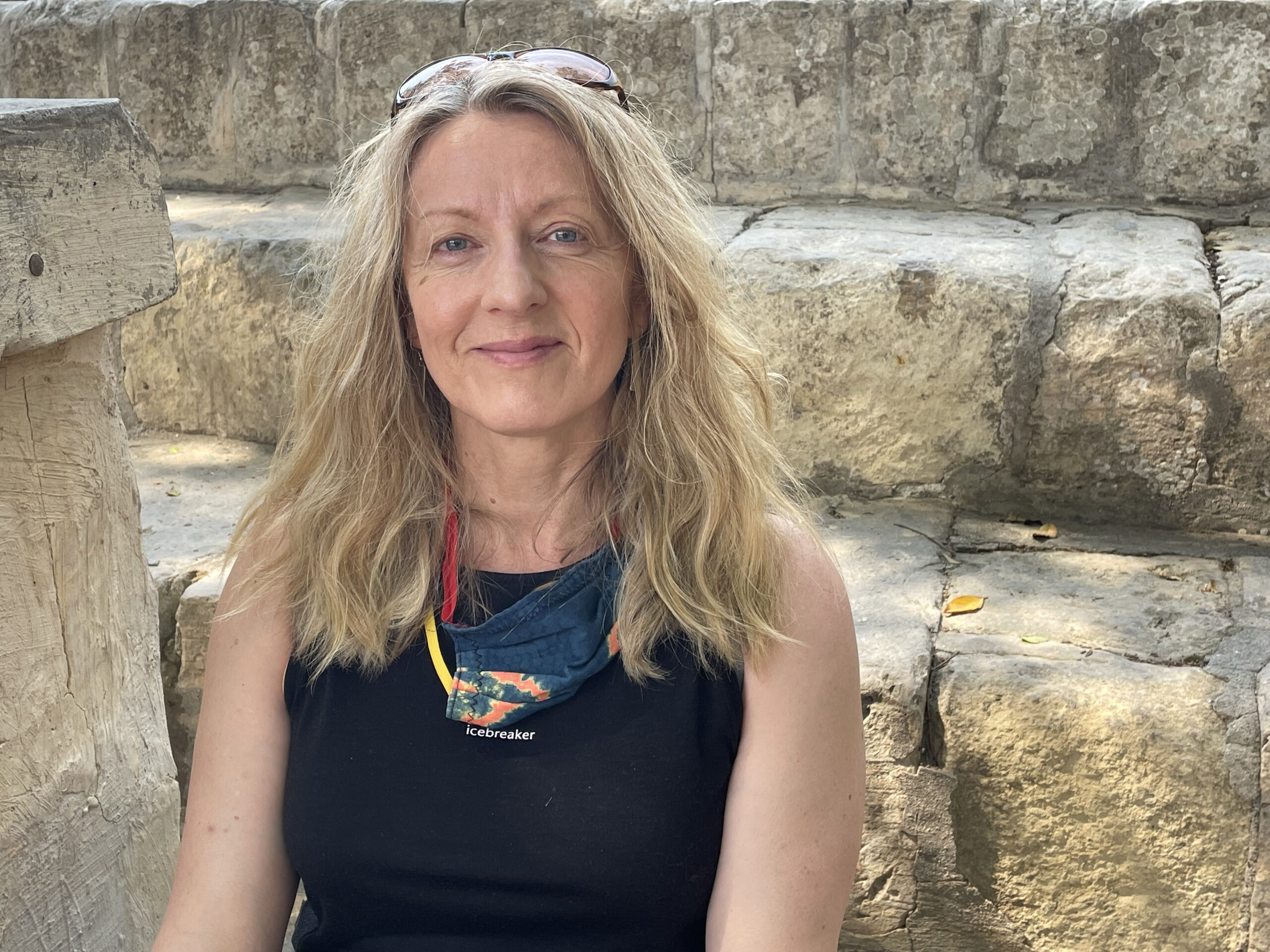
As the ‘90s progressed, the epidemic shifted as antiretroviral medications became available. An HIV diagnosis was no longer a death sentence. When she began her doctoral studies in the Department of English, Ruth also started teaching—one of the greatest things ever to happen to queer students at the U of A. As I have indicated, Ruth’s teaching is an extension of her activism. In her classes, including “Queer Literatures” and “Representations of AIDS” (a course she taught right up until COVID), she made space for difficult knowledges and conversations. Even “Tech Writing for Engineers” had sex-positive, AIDS-sensitive content. Moreover, she invited HIV-positive speakers into her classes, challenged moralism in nursing students, and once tried to get her students to wear T-shirts printed with “HIV+” to class. “There was resistance,” she said, “but it was a start.” Ever the intersectional feminist, Ruth’s teaching also went beyond queer content as she assigned work by women, Indigenous authors, and other marginalized groups.
After completing her Ph.D., in the ‘00s and ‘10s, Ruth was often in Europe, Africa, or Asia. In Europe, she was usually teaching at universities, and, if the environment was homophobic, finding and supporting the queer students. To protect identities, she is quieter about exactly what she did in countries where queer activity is a crime but, she says, it was usually effective. And then, back in Edmonton again, she’d teach at U of A or speak to staff at John Howard or other organizations about judgment and stigma or facilitate at the Altview Foundation for Gender Variant and Sexual Minorities.
The refusal to shy away from discomfort—political, pedagogical, emotional—is a throughline in Ruth’s work. It’s there in her early creative writing, published in queer academic and literary journals like Torquere, Prairie Fire, and Polari. It’s in her short plays performed on the Loud ‘n’ Queer stages in the 1990s and 2000s. It’s in her inclusion in anthologies like Out Here and Queering the Way, where her work helped map the contours of Edmonton’s queer literary culture. And it’s in her double receipt of the City of Edmonton’s Sheryl McInnis Pride Award (2007, 2011), which recognized not just academic excellence, but her deep, sustained commitment to 2SLGBTQ+ enrichment and advocacy. Even now, as her name grows on national and international stages, Ruth carries Edmonton with her. It was here that she cut her teeth as a writer and activist. It was here she became a teacher. And it was here that she learned to write with others.
Ruth’s most acclaimed work has come from her collaborations with the James Bay Cree of Northern Québec: The Sweet Bloods of Eeyou Istchee (2019) and E nâtamukw miyeyimuwin (2023)—literary volumes that tell stories of diabetes, residential school survival, environmental harm, and systemic injustice, but also of cultural strength and personal resilience. These books are not “about” the Cree; they are co-created with Cree storytellers, built on trust and shared purpose. Ruth’s role is never extractive. She is not a gatekeeper but a scribe with ethical clarity, making room for voices long silenced or misrepresented. This too is a kind of queer work—not because of content, but because of ethic. A refusal to separate the personal from the political, the aesthetic from the accountable. Her writing lives at the intersection of trauma and testimony, grief and grit.
And then there’s I (Athena)—fierce, funny, ferociously intelligent, and queer. Fans compare it to the work of Barbara Gowdy, and rightly so. Like Gowdy, Ruth refuses the sentimental. She has no interest in packaging suffering for easy consumption. Instead, she writes with the kind of unflinching honesty that insists on the complexity of survival.
Still, the classroom is where her legacy feels most immediate. The space she creates is electric and rare. You don’t just learn how to write there; you learn how to live with integrity. You learn how to sit with pain, how to make something of it, how to recognize what you owe—to the past, to others, and to yourself. You learn that stories aren’t just art; they’re strategy. As Kushner writes in Angels in America, “The world only spins forward.” Ruth would likely agree, but with a caveat: it spins forward only if we push it. Only if we fight for the lives that history tries to forget. Only if we insist that the stories that haunt us also teach us how to care. In Angels, the Angel America proclaims, “The Great Work begins.” Ruth’s life—her activism, her teaching, her writing—is a testament to that Great Work, carried out quietly, fiercely, with and for others. And if we’ve learned anything from her, it’s that the work doesn’t end. Not while we’re still here. Not while there are stories left to tell.

Funding for this story made possible by the Edmonton Heritage Council and the City of Edmonton




Kyler Chittick
Kyler Chittick is a Ph.D. Candidate in the Department of Political Science at the University of Alberta, an instructor in the political science and women's studies programs at NorQuest College, as well as co-director of Rainbow Story Hub. From 2020 to 2022, he was part of the Edmonton Queer History Project (EQHP) at MacEwan University.
Kyler's research interests land at the intersections of queer theory and critical sexuality studies as they pertain to law, film, cultural studies, and contemporary political theory. His academic work appears in Alberta Law Review, Porn Studies, Senses of Cinema, and Synoptique. He has also contributed to Inside Higher Ed, Syndicate, and the Rainbow Story Hub website.
 Rainbow Story Hub