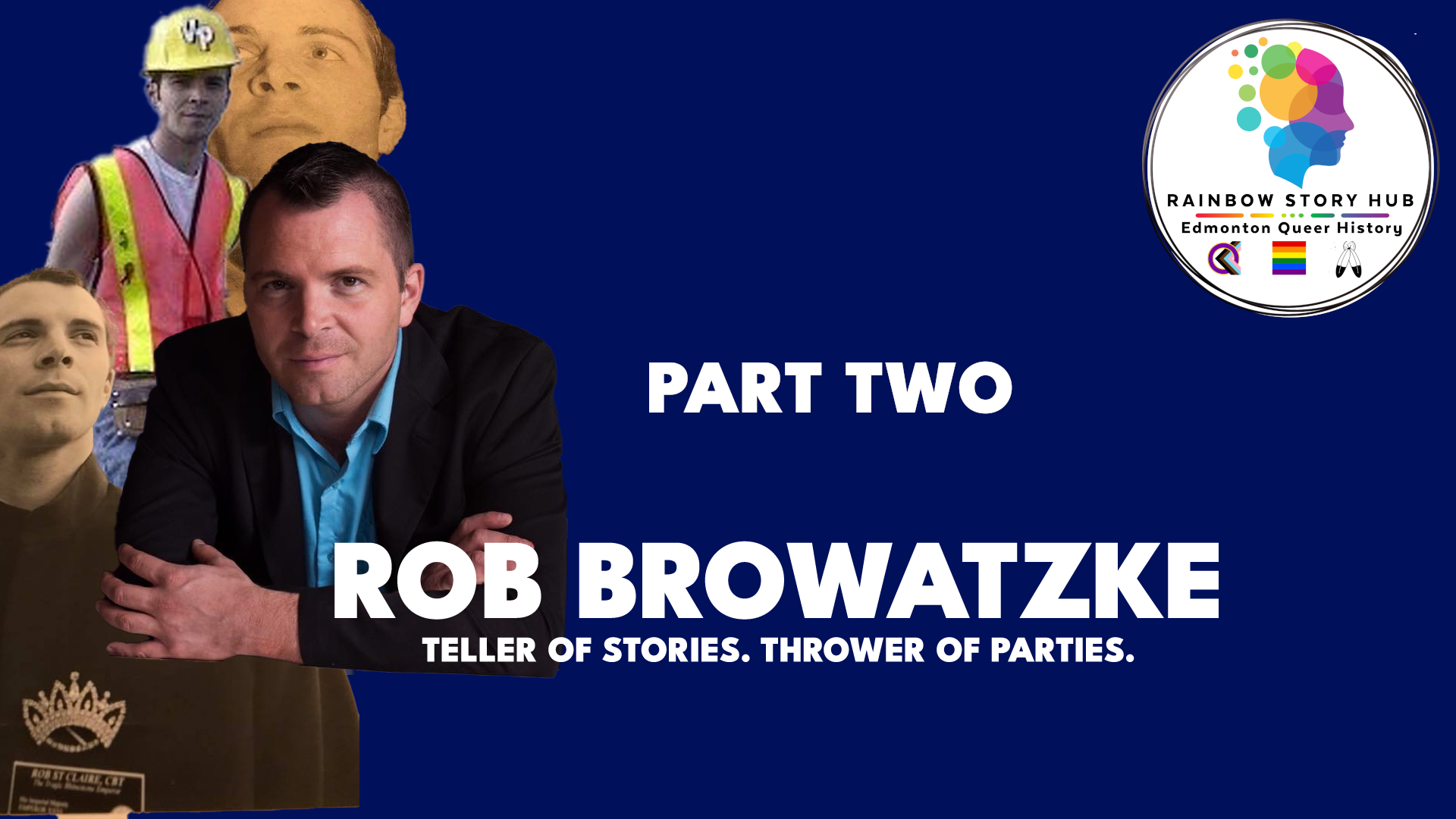
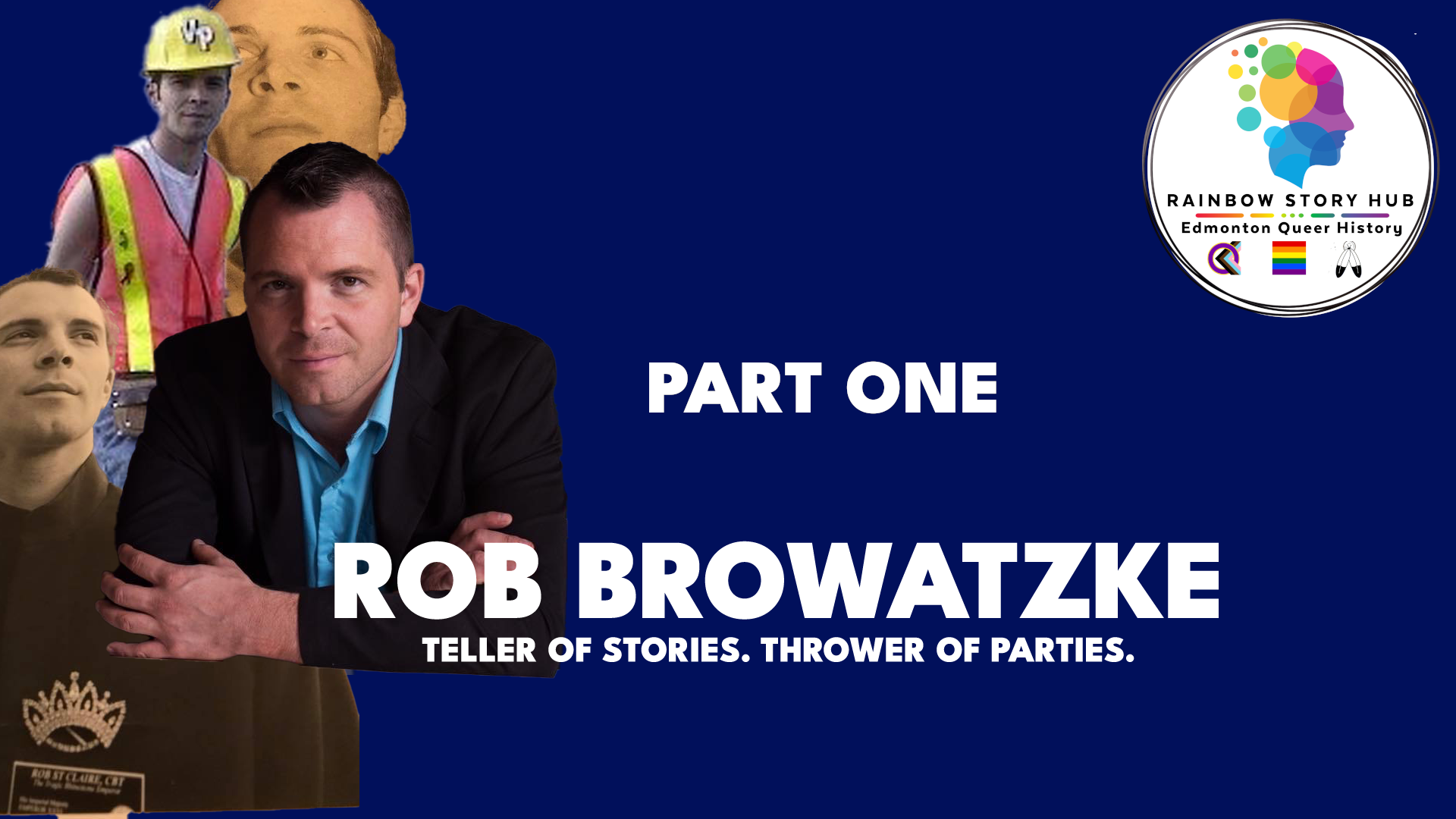
Part One: Rob Browatzke – Finding Community
Rob Browatzke’s story begins in the small decisions that change everything: the first night you walk into a queer space and the quiet, stubborn work of finding a place to belong. In this installment he remembers that first night at The Roost — a private club that, like many downtown rooms, became a classroom for a young gay man learning how to live out loud.
We follow Rob back to high school, where he came out and started navigating the complicated, often lonely realities that come with it — from friendships shifting to the challenge of feeling “other” while still trying to be normal. Those early years set the stage for a move to Lethbridge for university, where he first volunteered with peer support and began to build the skills and confidence that would steer his life and work.
After university Rob returned to the Edmonton scene and began a long career in queer nightlife — jobs at the Georgia Baths and the Down Under were among his first, bathhouse work that gave him a front-row seat to the city’s hidden histories and the resilience of its communities. He later shifted from the bathhouses to bars and clubs, working at places like Boots Bar, the Roost Bar, and Buddy’s Niteclub, each stop threading him deeper into Edmonton’s queer social life.
Parallel to his nightlife career was Rob’s work in queer media and community organizing: after contributing columns to publications such as Times.10, he co-founded Fresh Magazine in the early 2000s — a print voice that won local recognition and helped shape conversation in the community. He’s also been active volunteering with the Gay Men’s Outreach Crew (GMOC) and supporting the Edmonton Pride Festival, showing how his life in nightlife and his community work have always been two halves of the same story.
Part One is intimate and rooted in place: it’s about coming-of-age inside rooms that taught him how to survive and how to create. Expect memories of late nights and hard laughs, the awkward courage of coming out, the practicalities of moving for school and returning home, and the small, stubborn acts — putting out a magazine, volunteering a weekend, holding a mic at Pride — that turn a life into a legacy.
Additional Resources:
Rob Browatzke – Personal Website
https://browatzke.com/
Alberta 2SLGBTQI+ Chamber of Commerce – Member Spotlight: Rob Browatzke from Evolution Wonderlounge
https://ab-lgbt.com/member-spotlight-rob-browatzke-from-evolution-wonderlounge/
Edmonton City as Museum Project (ECAMP) – Author Rob Browatzke
https://citymuseumedmonton.ca/author/rob-browatzke/
Edmonton City As Museum Project – Q&A with 2020 Story Contributors Ron Byers & Rob Browatzke
https://citymuseumedmonton.ca/blog/qa-with-2020-story-contributors-ron-byers-rob-browatzke/
Goodreads – Books by Rob Browatzke
https://www.goodreads.com/author/list/7532183.Rob_Browatzke
Amazon.ca Books – Rob Browatzke
https://www.amazon.ca/stores/Rob-Browatzke/author/B00H3YSDGO
Why Edmonton – Drag shows and hot turkey sandwiches
https://why.edmonton.ca/stories/drag-shows-and-hot-turkey-sandwiches/
Show video transcript.
Rob Browatzke: Part One — Finding the Roost
The first time I walked into the Roost, it was April of 1996, and I had no idea then what a role gay bars were going to play in my life. My name is Rob Browatzke, and this is the story about all of the gay bars and the roles that they have played in my life.
The first time I walked into the Roost, it was April of 1996, and I had no idea then what a role gay bars were going to play in my life.
When I went to the Roost for the first time, I was living in Lethbridge and had come up to meet a couple of guys off IRC, an internet dating and social site that was in use in the ’90s. It was a Tuesday night — my first time at a gay bar — and I wish I remembered more about it. I’m assuming we went on Tuesday because there was a stripper; the Roost always had strippers on Tuesday nights. But I really don’t remember much about the actual experience. At the time, I wasn’t clueing into the fact that it was my first time in a gay bar, and certainly had no idea that gay bars were going to be as significant for me as they were.
At the time, I had only been out for a couple of years. I was going to the University of Lethbridge, barely involved with the gay community there because there wasn’t much of a gay community there. I certainly had no intention of gay nightlife becoming my life — which is what ended up happening.
Coming Out
I had come out in high school in 1993, about three years before that first Roost visit. I came out slowly, one person at a time — some people accepted it well, some not so much, and every time there was one of the “not so much,” I’d pull back a little. I had exploded out of the closet, and it was a complete disaster. Later on I’d refer to myself as my high school’s “token [slur],” which I think was the actual headline that ran with an Outlooks magazine article about my coming-out experience. I don’t think most people in my high school had any idea who I was — so the fact that I was out was a big deal for me, even if it wasn’t a big deal to anybody else.
When I graduated, all I wanted to do was get away from Fort Saskatchewan, where I grew up, so I went to the University of Lethbridge. Lethbridge in the mid-’90s — not that it’s much different now — was caught between very conservative Mormons and fundamentalist Christians, neither of whom wanted anything to do with gay people. Because my high school experience with my sexuality had been less than ideal, I went back into the closet.
That didn’t last long. There was a guy in my Psych 1000 class with floppy ’90s hair, so handsome, sitting right in front of me talking about homophobes in Lethbridge and how they could kiss his big gay ass. I thought: he is so pretty, and the only way I’m ever going to get to know him — and in my head, date him, marry him, spend the rest of my life with him and his gorgeous floppy ’90s hair — was if I came out again.
So I called the local gay and lesbian peer support line, the only listing under “gay” in the phone book (a big paper thing that had all the phone numbers in it, for you kids). They ran monthly dances and weekly coffee nights. I went to this little straight café in Lethbridge and sat there by myself for a couple of Thursdays. I could kind of tell who the gay people were — usually in the back room — and eventually someone came over and asked if I wanted to join them. I said yes, and after that there was no going back for me.
I started making friends, and I think that was what had been missing for me in dealing with my sexuality — knowing other gay people. In the ’90s that just wasn’t a given. A couple of straight friends in high school had once taken me to a place called Boytown Café, a little gay coffee shop they knew of in Edmonton, but we didn’t meet anyone — we just had a drink, and it was fine.
That changed in Lethbridge, where I got involved with the Gay and Lesbian Alliance of Lethbridge area, quickly becoming chairperson after everyone else on the board quit — as I’d learn tends to happen quite frequently in nonprofits. Running that organization, the weekly coffee nights, the monthly dances — that became who I was. Being the person who created community for other people became a defining part of my identity.
I was working toward an education degree, since I’d always been smart and good at school and everyone told me I should become a teacher. Coming out derailed that — all I wanted to do was talk about being gay, learn about being gay, and inject gayness into anything I was studying. So I gave up on teaching and just kept taking courses I was interested in, until after four years I ended up with a Bachelor of Arts in General Humanities that I’d paid $40,000 in student loans for, and that has sat collecting dust in my closet ever since.
Moving to Edmonton
After my degree, I decided to move back home and get a “gay job,” since I knew I’d be losing the community I had in Lethbridge. I figured a job at a gay business would be the best way to build connections in Edmonton. At the time there was a group called the Edmonton Rainbow Business Association, made up of gay-owned businesses, which put together an annual Pride Pages or Pink Pages directory. I found a copy and started applying at places in it.
The first place that called me back was the Georgia Baths. I’d been to bathhouses before — F2 in Vancouver, Goliath in Calgary, Down Under in Edmonton. I’d actually wanted the job at Down Under, but the Georgia called first. I didn’t like working there and it didn’t last long — it was on a sketchy side of downtown, and if I was looking for community, these weren’t the people I wanted to build it with.
Luckily it was only a couple of weeks before Eric McCorriston, the manager of Down Under, called me in for an interview and hired me. I quit the Georgia in a less-than-professional way and got the job at Down Under — where my life really, really changed.
Down Under and the Village People
Down Under had opened in 1998; I’d actually visited not long after it opened, when there still wasn’t power in all the rooms and it was still under construction. It was owned by three people — Jim McBride, David Taylor, and Jim Schaefer — who would go on to change my life significantly, especially Jim McBride.
Jim McBride was a past monarch with the Imperial Sovereign Court of the Wild Rose. At the time I had no idea what that was. He was also a member of a dance troupe called Edmonton’s Impersonation Review of the Village People, which would soon reshape my life again. The three owners together had been involved in Edmonton’s queer nightlife forever, and through them — particularly Jim — I started making all the connections I wanted in my life.
The summer of 1999, when I moved back and got the Down Under job, was a great summer, and the first thing Jim got me involved in was the Village People. The troupe had started a few years earlier as a fundraising group. When they were about to fire one of their members, Jim asked if I wanted to join. I said, “I cannot dance” — and anyone who saw the Village People perform knew that was true; don’t even get me started on my difficulties with a basic kick-line. But I wanted to be part of it because it seemed fun, and the people in it were all cool and involved in Edmonton’s gay nightlife — which was all I really wanted.
We rehearsed Wednesdays at the Roost, which at the time was the main gay dance club and watering hole in the late ’90s. That’s where I spent almost the entire summer when I wasn’t at Down Under — me, Jim McBride, Bobby (who worked at the Roost), Jazzy (who DJed there), Carl (the Roost’s manager), and Ron Byers. The six of us would rehearse for a couple of hours, then go downstairs and get hammered together, talking about Village People merchandise we should put out because we thought we were the biggest deal in the world — Village People mouse pads, Village People placemats. It sounds a little delusional looking back, but it was so much fun.
Joining the Court
Through the Village People, I got involved with the Imperial Sovereign Court of the Wild Rose, a fundraising organization just a little older than me. Even though many of the places I’d work and organizations I’d join would come and go, my connection to ISCWR is the common thread running through it all.
When I joined the Village People in ’99, Ron Byers was just about to run for Emperor — convinced he’d win this time, having run before and lost, but having planned it for eight years, so nobody was foolish enough to run against him. He asked me to run as one of his princes. I had no idea what that meant, but it sounded fun, and I said I’d only do it if my good friend Jim did it too — since at the time Jim was my boss, my dance troupe leader, my landlord, and everything I wanted to be in life. He was successful, he knew who he was, he had a confidence I’d never had and really aspired to.
So I told Ron: yes, I’ll be your prince if I can do it with my friend Jim. That’s how I joined the Court. Over the years I would go on to be Emperor four times and Prince twice — I’ll come back to some of those moments as they come up.
Boots and the Roost
One of Down Under’s owners, Jim Schaefer, also owned a bar called Boots — the older bar, the leather bar, the bear bar. I didn’t spend a lot of time there, but I needed a second job since Down Under wasn’t paying my rent (and Jim, my landlord, was very insistent that I pay it). So I took a part-time job at Boots as well, working there alongside Down Under. I liked it, but it wasn’t a long stint — after a couple of months, Carl offered me a job at the Roost, which was younger, more fun, and I figured I’d make more money.
I thought I could work all three — Down Under, Boots, and the Roost. It’d be great: all the community, all the connection I was after. What I didn’t know was how much internal gay-bar politics would redirect my plans. Jim Schaefer said if I was going to work at the Roost, I couldn’t work at Boots. So I had to choose, and I went with the Roost — the more fun option — and quit Boots. It wouldn’t be the last time I quit working for Jim.
Working at the Roost was everything I thought it would be, except the bartending shifts I’d been promised never materialized — instead I got porter and deli shifts. The Roost Deli was where I spent most of my time, which I didn’t mind even though it felt cut off from the rest of the action. It was where everyone came to get cash out, since there wasn’t an ATM at the Roost at the time, and everyone wanted a Roost hot dog or burger. Being a bit removed from the rest of the bar, it was quieter, and it gave me the chance to talk to people — and to bask in the glory of our 24×36 Village People picture hanging on the wall, because yes, we were that pushy.
That job didn’t last long either — it wasn’t compatible with everything else going on. Village People needed time off for trips, and I was Prince and then immediately Emperor — Prince for Ron, then Emperor 26. I needed time off for that too, and while Jim at Down Under could influence the schedule (since his partner Eric did the scheduling), he didn’t have that kind of pull at the Roost. So I had to choose between being a showgirl and having an income — a challenge any drag performer in the city can relate to, balancing money and glory. I chose the glory, such as it was.
That put me into about 2002–2003.
Losing Down Under
In the spring of 2003 I got fired from Down Under — partying and drinking a little too much, until eventually enough was enough. Looking back, part of it was frustration with how much of a dead end the job had become, even though I’d started doing marketing, promotions, graphic design, and website work for the bar. There had always been a carrot of eventual management dangled in front of me, and it wasn’t coming quickly enough, which checked me out a bit.
Eric called me and said, “Young Rob, your services are no longer required” — and that was the end of my first stint at Down Under. About a month later, Eric passed away. Him firing me was the last time I ever spoke with him. That was the first time I started linking grief in a big way to my experiences in gay nightlife — something that would become a recurring thread as more people in my life passed away over the years.
Pride, Fresh Magazine, and Buddies
In 2002–2003 I was also on the board of the Edmonton Pride Week Society — probably through my Court connections, since Ron was also on the Pride board when I was his Prince. The 2003 Pride season was nearly derailed by ugly transphobia among board members, which led to most of the board quitting, and one member going to police, fire, and the city to cancel all our plans just two or three months before the event. That left me as the only person on the board for that Pride season. Luckily I knew enough skilled people in the community — people like Mickey Wilson and Marie Billet immediately stepped up — and we pulled off a great Pride.
Around this time I’d also been writing for Times Ten, a monthly magazine, since 1999 — I’d met the editor, Dennis Campbell, through Jim McBride again. Dennis also ran Pride Video, which supplied all of Down Under’s porn rentals. By 2003, though, I felt Times Ten had shifted its focus toward American politics and away from being fun and gay — I remember an issue with a nuclear bomb on the cover that made me think, this isn’t what I want to write for anymore.
So my friend Michael Brown, a talented artist, and I decided to start a new Edmonton magazine called Fresh, financed mostly by our boyfriends at the time while we waited for advertisers. The first issue came out in the fall of 2003. I assumed — wrongly — that I’d have no trouble landing advertisers, given how many gay businesses I’d worked for. But the first business to sign on was Jim Brown’s Buddies, Woody’s, and Steamworks, and because of Edmonton’s gay-business politics, once Buddies came aboard none of the other businesses would advertise with us — even businesses I had personal and professional relationships with. So Fresh ran with ads from Buddies, Woody’s, and Steamworks, while Times Ten ran ads from Down Under, Boots, and the Roost. It became a divide in the community.
That divide redirected my life again, since naturally I started spending my time at the business supporting the magazine I was building — Buddies. By then I wasn’t reigning in the Court, and the Village People were on one of our many hiatuses, so some of those social connections had loosened, giving me more room to spend time at Buddies, which was starting to dominate the scene in the early 2000s and transform it from a Roost-based scene to a Buddies-based one.
Edmonton had always been a bit unusual with its dance clubs — one club owned one night, another the other, a pattern that predated my time in the city (there was Flashback night and Roost night before). By the mid-’90s the Roost had a stranglehold on Saturday nights, but Friday was Buddies night — a phrase that would haunt, and define, much of my time at Buddies for years to come.
Fresh pulling me into Buddies gave me a relationship with owner Jim Brown, and in August 2004 he called to say they were letting their manager go and asked if I was interested. I thought he was calling to yell at me for being very drunk at Buddies the night before. But the timing was good — Fresh was almost a year old and not making money, I hadn’t been working steadily, and a stint with Gay Men’s Outreach Crew (a peer education and resource group for gay men around coming out, HIV, and STIs) wasn’t sustainable. So I said yes, and started managing Buddies.
Unfortunately, Fresh fell by the wayside — since it wasn’t making money anyway, that wasn’t the end of the world financially, but it was hard to lose something we’d worked so hard on. We’d probably damaged Times Ten financially enough in the process that it didn’t outlast Fresh by much either — the creation of one thing ended up costing both of them.
That’s what led me into managing Buddies. 2005, managing Buddies, was probably a high point of my life — it was the hottest club in town, and we were stealing business from the Roost constantly, including their Sunday shows with our Stardust Lounge featuring Binky and Vanity. I was running the hot bar, I had a hot boyfriend — it was a genuine high point. I spent most of my time making sure everyone had a great time and taking pictures of everybody.
At the end of 2005 we decided to turn all those photos into a yearbook for our New Year’s theme — Buddies’ Senior Prom. I hadn’t anticipated how big a project that would be, and I started falling behind while still trying to do my actual job. I needed more hours in the day — and I figured the only way to get them was to say yes when a friend and coworker offered to help me stay up later with some cocaine.


Rainbow Story Hub
Rainbow Story Hub brings the history of Edmonton's 2SLGBTQ+ community to life from the perspective of those who lived it. Through stories, videos and other media we hope to capture and preserve these stories from the people who lived them. These stories can then be used to inform, educate and enlighten not only our own community through GSA’s and hopefully one day school curriculum but also the greater community we live in today.
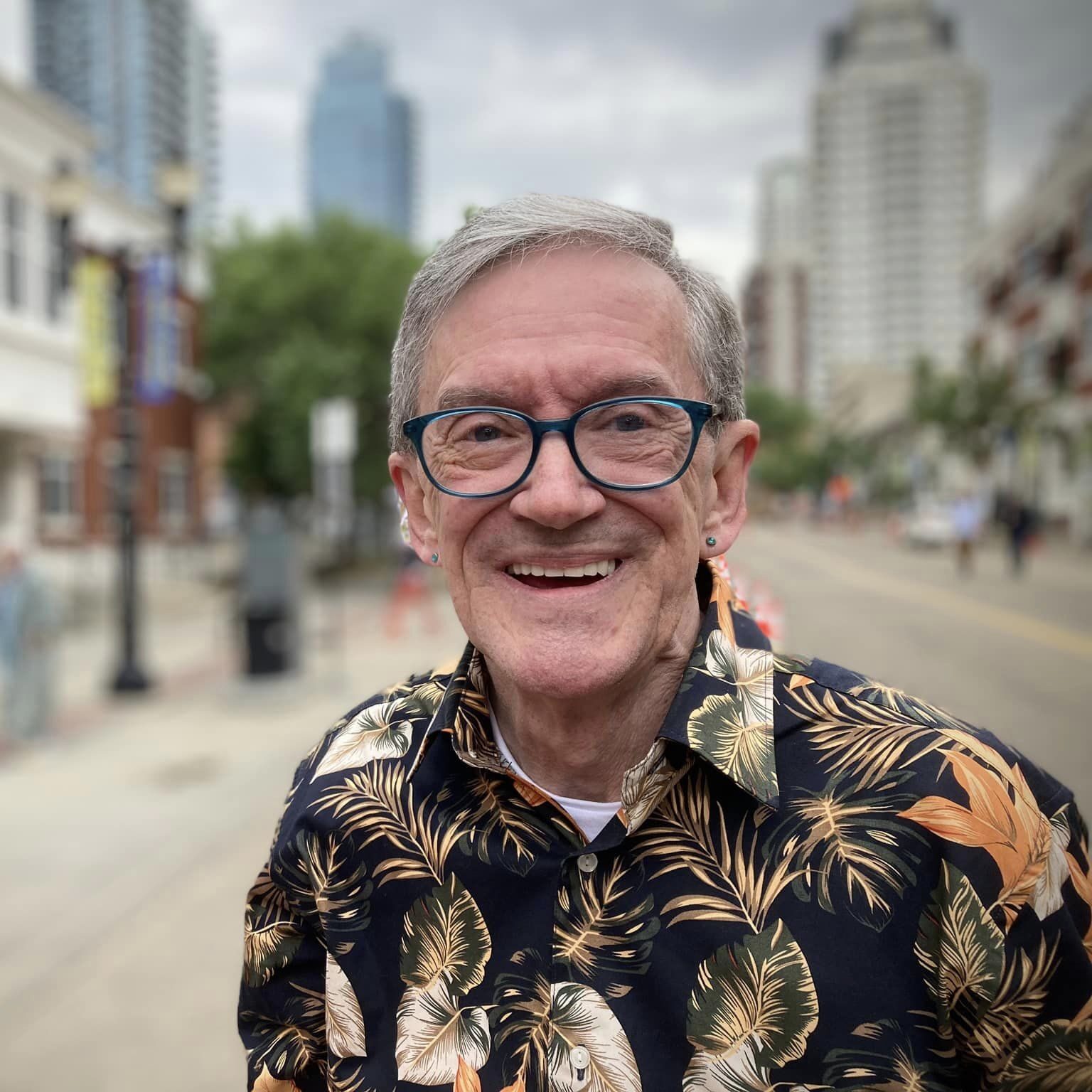 Ron Byers