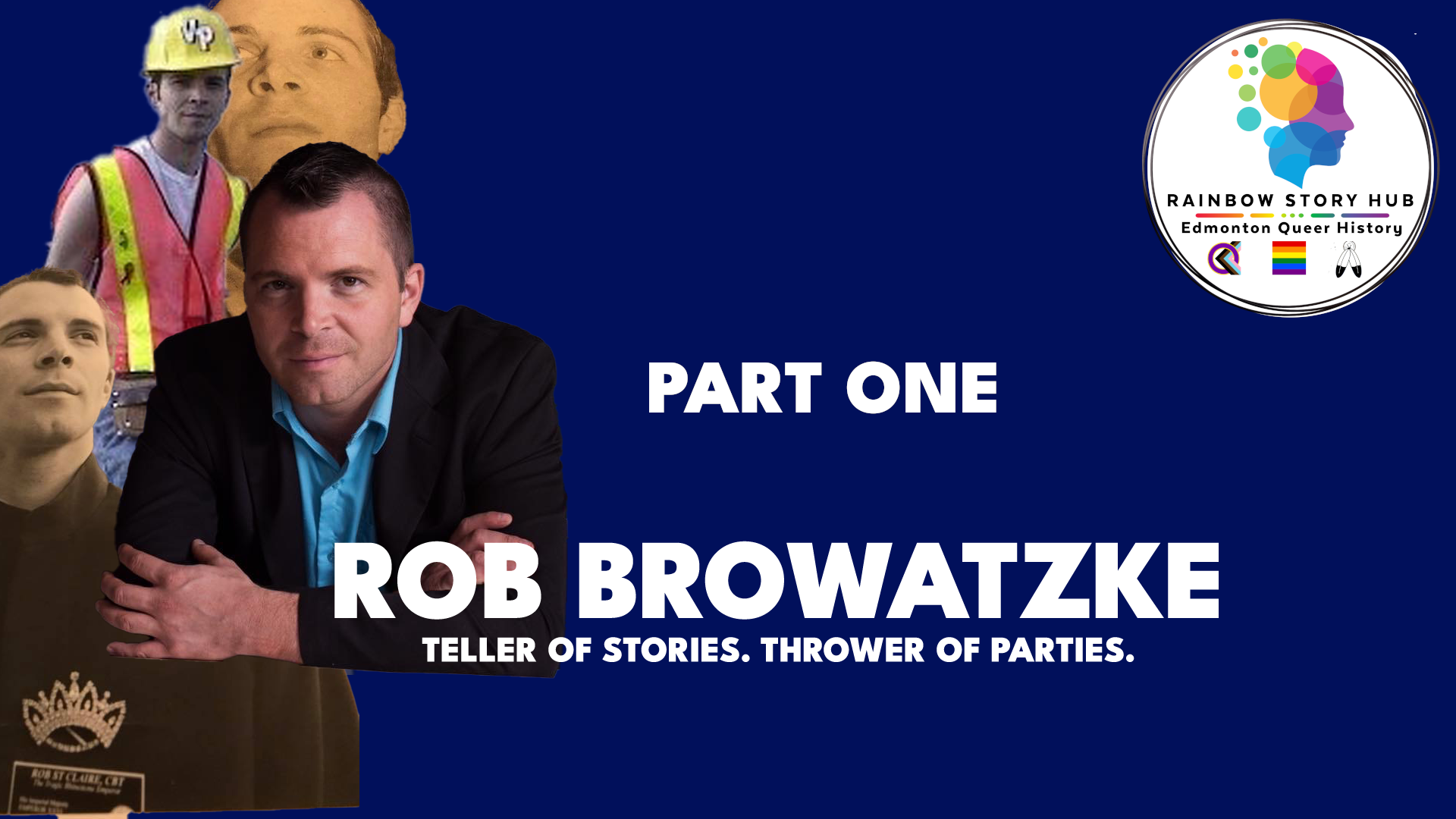
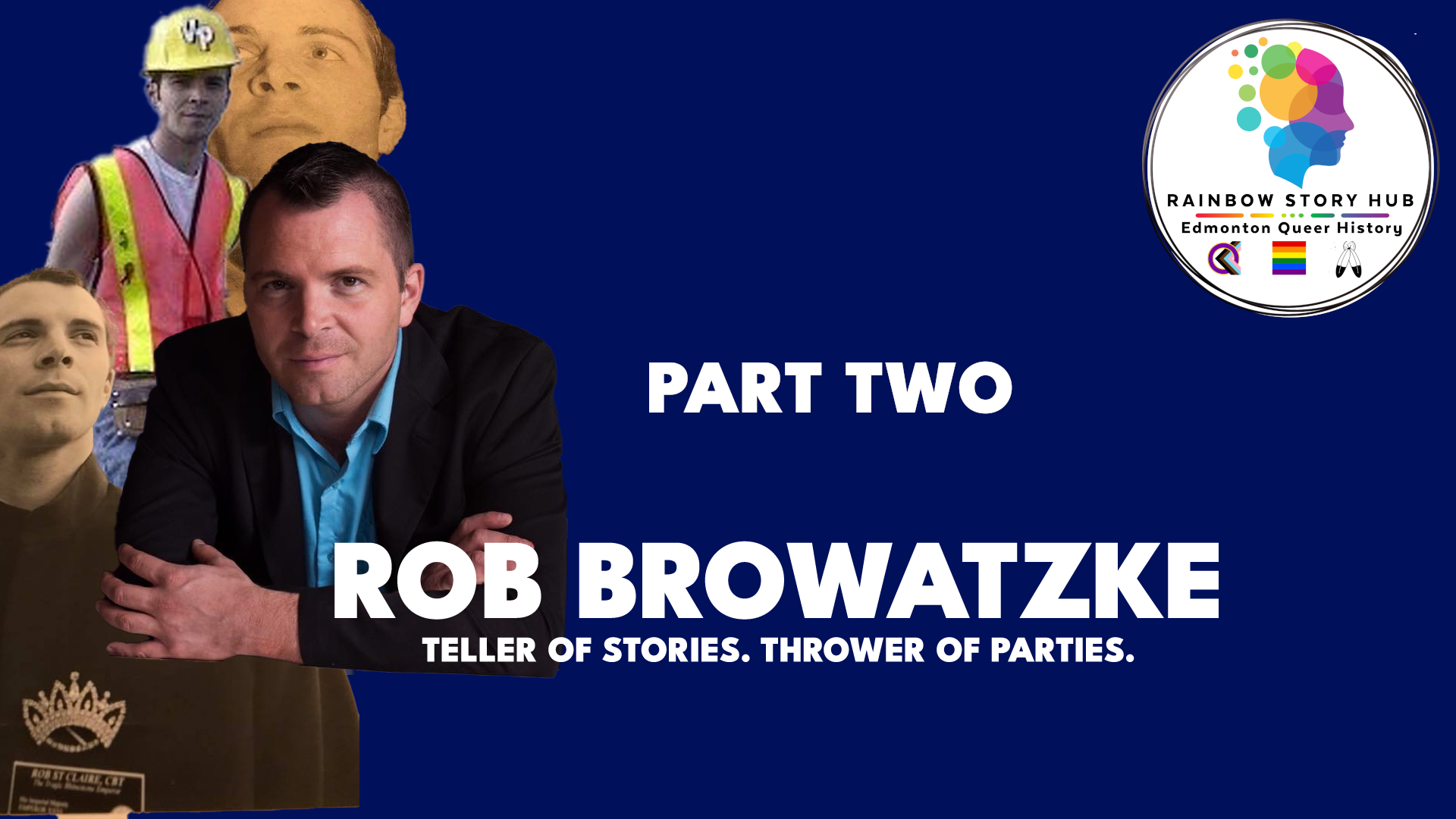
Part Two: Rob Browatzke – Recovery, Resilience, and Evolution
In Part Two, Rob Browatzke opens up about a darker chapter — how success in Edmonton’s nightlife scene gave way to a growing addiction to alcohol and cocaine. He reflects on the toll it took on his work at Buddy’s, Steamworks Bathhouse, Down Under, and Boots, and the hard truths that came with losing direction in the very community spaces that once gave him purpose.
After the passing of the Boots Bar owner, Rob found himself searching for stability, taking on new roles at Prism Bar and later at the Junction Bar & Grill. It was during these years that he began the long road toward sobriety — a turning point that reshaped his life and career.
Rob shares how, with the support of his uncles, he helped launch Evolution Wonderlounge in 2013 — a venue that quickly became Edmonton’s premiere queer bar and dance club, a home for drag, music, and community connection. He also reflects on the upcoming emotional closing of that iconic space and the hope that comes with EVO, a new chapter that opened in the spring of 2025.
Part Two is a story of recovery and renewal — proof that even after loss and struggle, evolution is always possible.
Additional Resources:
Rob Browatzke – Personal Website
https://browatzke.com/
Alberta 2SLGBTQI+ Chamber of Commerce – Member Spotlight: Rob Browatzke from Evolution Wonderlounge
https://ab-lgbt.com/member-spotlight-rob-browatzke-from-evolution-wonderlounge/
Edmonton City as Museum Project (ECAMP) – Author Rob Browatzke
https://citymuseumedmonton.ca/author/rob-browatzke/
Edmonton City As Museum Project – Q&A with 2020 Story Contributors Ron Byers & Rob Browatzke
https://citymuseumedmonton.ca/blog/qa-with-2020-story-contributors-ron-byers-rob-browatzke/
Goodreads – Books by Rob Browatzke
https://www.goodreads.com/author/list/7532183.Rob_Browatzke
Amazon.ca Books – Rob Browatzke
https://www.amazon.ca/stores/Rob-Browatzke/author/B00H3YSDGO
Why Edmonton – Drag shows and hot turkey sandwiches
https://why.edmonton.ca/stories/drag-shows-and-hot-turkey-sandwiches/
Show video transcript.
Rob Browatzke: Part Two
The first time I did cocaine was at Vancouver Coronation in 2002. It wasn’t something I’d ever really thought about doing — it was just something my friends there were doing, and it seemed like a good idea. We had a good time. My name is Rob Browatzke, and this is the second part of my story.
After Vancouver Coronation, a month or so later, we were in Calgary for their coronation ball and did some cocaine again. It was a good time, nothing exciting — nothing I really anticipated changing my life. At Edmonton Coronation in August of 2002, I did it again and didn’t really have a good time, so I thought, yeah, I’m done with this. But then at the end of 2005, the circumstances in my life were just different, and it became a very regular thing — starting as something to keep me awake or sober me up a little to work on a project, then quickly becoming everything.
By this point I’d been in nightlife for six years, and certainly not sober. Anyone who knew me knew I was kind of a hot mess drunk — it was the early 2000s, and I think most of the people I was hanging out with were the same. We were at the bar seven nights a week, and that usually involved copious amounts of alcohol — large jugs of beer, shots of sambuca, more shots of sambuca. Alcohol had always been a big part of that experience, and even when I got the job at Buddies, one of the first things Jim told me was that as host of the party, I could keep drinking while working, because you want everybody else drinking and having a good time.
Cocaine shifted that so much that by the middle of January — about two weeks after what was really the first time as far as the addiction went — I realized it was such a problem that I needed to stop. I was about to go to Palm Springs to visit my uncles Murray and Scott, who had a gay hotel there; Jim Brown had bought me the trip as a bonus for doing a good job. I told myself I’d get back from Palm Springs and be done with it. Instead, we did cocaine right up until I took the cab from Buddies to the airport. I had a great time in Palm Springs, still drunk the entire time, and then my plane landed and I cabbed directly to the bar — the first thing out of my mouth was asking if anyone had any cocaine.
The part I think I feel the most guilt about is that it wasn’t just me going down that road — I was taking everyone with me, including people who worked for me as their manager, along with coworkers, performers, and customers. It wasn’t a well-kept secret; there was a revolving door of people in and out of my office at Buddies. It didn’t last much longer than that — I got back from Palm Springs in January, and by May I was laid off. Jim called me into his office, much as he had two years earlier to offer me the job, and told me he could see it was getting sloppy — that he didn’t think I was stealing from him, but that he’d been through this with other people before, and if I wasn’t stealing yet, I would be. He said they’d lay me off so I could claim EI and get some help, and that this wasn’t necessarily the end — but it was, for now. It was the end of my time at Buddies, and for years I’d look back on that as the watershed moment I wanted to get back to.
I was having a great time. I wasn’t working, had no idea where the money was coming from — probably the EI — and the alcohol and cocaine just got worse, because now I had nothing to do. At least when I’d been working at Buddies I’d had somewhere to be. Now people would come over after the bar and we’d party for a couple of days. I wasn’t banned from Buddies, but I was strongly discouraged from going. Because my job there had broken most of my other connections, I was forced to look for work outside the gay community, with people who didn’t know me. One connection that hadn’t been fully severed got me my first “straight” job — Ron, my friend from the Village People and my Emperor, was working at a call center for a pizza delivery service, and I got a job there too. I was still actively using — in my defense, I managed to put through orders very quickly because I was flying on cocaine — but that didn’t last. I got a job at Telus after that, and it also didn’t work out, because I couldn’t stop partying.
That puts us into the spring of 2007 — my 30th birthday. I wasn’t working, had just been fired from Telus, and had been planning to move in with my best friend at the time, until that fell apart because he’d upgraded from cocaine to meth and I didn’t want to go down that road. One night the fire alarm was going off in my building, and all I could think was that I didn’t care if the building burned down — this wasn’t a life. My ex happened to be coming over, saw I wasn’t leaving despite the alarm, and that’s when everything about the position I was in started coming out. He said we were going to get this fixed, and I moved in with him for a couple of weeks on the condition that I start putting my life back together.
Ironically, that meant getting a job at Steamworks — working for Jim Brown again — which mostly meant staff pricing on alcohol, which meant more money left over for cocaine. I couldn’t live with my ex for very long, and became actively homeless, moving into the bathhouse I was working at. Nobody else in my life really knew what was going on, and I don’t think anyone particularly cared at that point. Then, getting drunk at Boots one night, Jim Schaefer offered me a bartending job there, which changed my life again — Steamworks had fired me by then (the second time I’d been fired from a Jim Brown business, if anyone’s counting). I started working for Jim and Ross at Boots, got a roommate I knew from Buddies, and had reached a level of addiction where I was a very functioning alcoholic and drug addict — enabled heavily by my time at Boots.
Boots in 2007 was very much on its way out — it had never been busy in my time there, more Jim’s private party space with the same people all the time. It was very much a family, but one either right on the alcohol train with me, or later in the night on the cocaine train, or turning a blind eye to everything going on. There are a lot of stories from that 2007–2009 period at Boots, including another run at the Prince title with the ISCWR, but looking back, it’s really all about the addiction. To give a sense of what it was like: there was one Friday I showed up for a 4 p.m. shift, having gotten out of bed around 3 after partying the night before, started drinking at work, kept partying all night after my shift ended, was back for my 4 p.m. start Saturday, did it again, and was back again Sunday — at one point I was at Boots for roughly 40 hours straight. There’s no way anyone around could have thought that was healthy, but that’s just what it was — and it’s hard for anyone to diagnose a problem when everyone around you is going through the same thing. I was aware I needed to quit, and became one of those New Year’s resolution people — four days sober in 2008, nine days in 2009, ten days in 2010.
By 2010, though, I wasn’t really thinking about my own addiction, because we were watching Jim Schaefer slowly pass away — his health destroyed in large part by his own addictions; he was a heavy smoker and a very heavy drinker. We sat on the corner of that bar and watched him decline, and in March of 2010, when we got the call that he’d died, Ross and I spent most of the day drinking, because that’s what you do with grief. None of us had a plan for what came next — the idea of Boots without Jim seemed impossible, but we gave it a go anyway.
Then, on Monday, May 31st, 2010, while I was hosting bingo, Ross called me over mid-game and told me to get everybody out. No one was surprised — his moods weren’t foreign to anyone — so I called the last game, everyone left, and Ross told me we were done: that was the last night, the bar was closed. We got drunk and got high, and at 9 the next morning he drove me home with all the mementos I’d scavenged from around the bar. I posted on Facebook that Boots was closed, then passed out.
I don’t know what my life would have looked like after that if I hadn’t gotten a phone call, once I woke up, from Devon and Tracy at Prism, offering me a job. It wasn’t just about me getting work — it was about all the people from Boots finding a new home, since none of them were Buddies people or Woody’s people, and the Roost was long since closed. We had nowhere else to go, and it wasn’t as simple as finding somewhere else to drink — it was about connection, even when those connections were dysfunctional, harmful, dangerous, and destructive, they were also very strong.
So everyone came with me to Prism, which was on 101st Street in a rough neighborhood at the time, with a lease coming due and a search on for somewhere bigger and better located. They took the opportunity of Boots closing to relocate into the old Boots space, rebranding it Junction — bringing together Boots, Prism, and part of Play. Junction opened in August of 2010, and it was everything Devon and Tracy wanted it to be. Unlike Ross and Jim, they had zero tolerance for anything happening on duty in the space — it was their livelihood and investment, and whatever you did off duty was your business, but not in the bar.
I tried to dry out a bit working there and respected those boundaries — I wouldn’t have had a choice, they wouldn’t have tolerated otherwise — and because I was only working a couple of days a week, I didn’t have much extra money for partying on weekends. But being back in that physical space brought the urge back almost immediately — not that I’d really stopped using, but I started using more regularly again. It didn’t take long before Devon and Tracy told me to get it together or we were done; they’d already taken my key away because they couldn’t trust me to lock up. At Boots, Ross and Jim had just accepted that I’d come back with a crowd after other bars closed and we’d party all night — Devon and Tracy wanted nothing to do with that.
By this point my alcoholism was outpacing my cocaine problem. I’d found a rhythm of using cocaine to sober up enough to keep drinking, then drinking enough to pass out — beer and blow was my poison. But at the end of 2010 into 2011, I started mixing in hard liquor as well, drinking straight shots of gin without cutting back on anything else, and I was blackout drunk essentially every night through January and February of 2011. Finally, one Tuesday morning after partying all night, I woke up and decided I was done. March 22nd, 2011 was the last beer and the last cocaine — and for some reason, that time it stuck. There’s never been any going back since.
That changed everything again. It changed how I was at work — I couldn’t blame mood swings on drinking anymore, and while I didn’t have real withdrawal, I was a lot more focused. I found myself thinking about what my life could have looked like if I’d gotten sober years earlier — the trips I could have taken, having a car for the first time in years, since for so long my entire world had been a few city blocks because that’s where all my bars and dealers were, and I hadn’t wanted to go anywhere else. That changed after I got sober, and I suspect everything I’ve done since, including traveling the world, could have started while I was still working at Junction, sober.
But that wasn’t to be — about a year after I got sober, Devon and Tracy called me into the office to say they were shutting down. The landlord was exercising a demolition clause in the lease to redevelop the space, and in September of 2012, Junction closed. That space had been a gay bar for 42 years, and I’d only been part of it for 13 of those — but its loss reverberated through the community regardless.
I don’t know what I would have done next — probably ended up back at Buddies, since I’d already started hosting karaoke at Woody’s and that door was open. But right around the time Junction closed, I got a call from my uncles in Palm Springs. They were selling their hotel due to economic conditions in the U.S. and wanted to relocate — they suggested I move to Calgary with them to open a bar or club together. The timing was fortuitous, since everything I’d been doing had just ended and I didn’t know what was next; being sober by then, I also had some savings and time to think it over.
I had zero real interest in moving to Calgary — Edmonton was home — but Murray and Scott were family, even though we hadn’t spent much time together in years while they were in California. I figured it was a good opportunity for a fresh start, and I’d had plenty of those already. The trouble was we couldn’t find a space in Calgary that would allow a gay bar, or that was priced right, and after months of searching I wasn’t finding the community or connection there that I was used to — though I recognized that takes time to build. It became easy to just head up to Edmonton for weekends to see friends, and on one of those trips I noticed a space we’d known as a gay bar before — most recently as Play, then called The Warehouse — was for sale.
Even though we were all settled in Calgary by then, with my uncles having just bought a house, I suggested we at least go look at it — pointing out my connections and community ties in Edmonton. That’s what ended up happening: we looked at the space, the price and location were right, and Edmonton was heavily invested in the Ice District at the time, so we’d be positioned to benefit from the new arena transforming downtown.
We opened Evolution in September of 2013 — a little piece of Vegas meets Circus. At the time, Evolution was one of four gay bars in the city, alongside Upstairs (which had opened just five months earlier) and Buddies and Woody’s. As soon as we announced Evolution, I got barred from Buddies and Woody’s for the second time — I’d been barred once before, just prior to getting sober, which had actually been one of the driving factors in my getting sober in the first place. It wasn’t a surprise, if unfortunate; it would have been nice to work with them from the start. We did work with Upstairs, running a joint pub crawl, but Edmonton was very much a two-gay-bar city at the time — one bar owned Friday night, the other Saturday. Buddies had Friday, Upstairs had Saturday, and when Evolution came along and took Saturday, that left nothing for Upstairs, so they pivoted to a straight bar the day after our first joint event, on Halloween that year.
It’s been me, Murray, and Scott with Evolution ever since. In the twelve years since, it’s been truly amazing — I think we’ve done wonderful things for the city and expanded our family enormously, from just the three of us as owners to include staff and the hundreds of performers who’ve graced the stage. One of the early things we did was bring back weekly Sunday Night Drag, which had been part of Edmonton nightlife throughout my time in it but had fallen away for lack of a venue. We also started a provincial contest for Alberta’s Drag Superstar, initially in partnership with Pure Pride and later taking it over solo in our second year, along with bringing in guest DJs, adult performers, and working with as many community groups and neighboring businesses as were willing.
Unfortunately, some neighbors had zero interest in working with us — our upstairs neighbors disliked us from the start, having previously been above a nightclub that only opened late at night, whereas we ran a lot of early shows: drag, fundraisers, burlesque, all starting earlier in the evening and getting noisy sooner. That tension came to a head in 2019 into 2020, when we renegotiated our lease and noise restrictions were redefined — we didn’t have a choice, since the lease was coming due regardless.
A lot of the community’s concerns about Evolution centered on its basement location — it wasn’t accessible, and people didn’t want to do happy hour underground. When we opened, we ran seven days a week including happy hour, but that didn’t last; nobody wanted to sit in a dark room in the late afternoon, even though I pointed out that Boots had done just fine for years on that model. The Ice District boom we’d hoped to benefit from never really materialized either, and then, right after we signed the new lease at the start of 2020, the pandemic hit. We pivoted repeatedly, took grants, took loans, and did everything we could to keep the business afloat, because by that point it wasn’t just our livelihood — it was who we were. The city knew us as Evolution; it had been 21 years of this life for me at that point, and it was more than a job, it was my life.
Toward the end of 2024, we learned our lease was coming due again. We asked the landlord for a two-year extension — we were still not getting along with our upstairs neighbors, but wanted time to recover from COVID debt. The landlord refused, telling us our lease would end at the close of 2025 and would not be renewed. It felt like a bit of a slap in the face at first, but we chose not to take it that way — instead treating it as an opportunity to find a space that could do everything we were already doing well, better.
By the end of 2024 we’d been the only gay bar in the city for seven years, so clearly we were doing something the community wanted — but we knew we could do more with a more accessible, street-level space with a kitchen and windows. A lot of people who’d been part of my life for years — the older Boots crowd, the “cougars” from Prism and Junction, the Bears we’d hosted great events with through the Fellowship of Alberta Bears — ultimately wanted food options or earlier events that our basement space couldn’t really offer. So those connections I’d built and hoped to lean on for Evolution’s continued success weren’t fully materializing in that location.
We started looking elsewhere and found a new space, but had to take it right away rather than waiting until year-end to avoid double-renting. That led to what we dubbed our “two gay bar summer,” running both the original 103rd Street location and the new 115th Street space simultaneously, trying not to compete with ourselves — and I think we succeeded. Now, in the fall of 2025, our original space is shutting down: November 8th, 2025 will be the last night at the OG location, after which shows and dancing move over to the new space, opening a new chapter.
That’s my story so far. Like I said at the beginning, it’s all about community and connection. Those connections have only deepened over the years, and I’m looking forward to this next chapter, where they continue to grow.


Rainbow Story Hub
Rainbow Story Hub brings the history of Edmonton's 2SLGBTQ+ community to life from the perspective of those who lived it. Through stories, videos and other media we hope to capture and preserve these stories from the people who lived them. These stories can then be used to inform, educate and enlighten not only our own community through GSA’s and hopefully one day school curriculum but also the greater community we live in today.
- Rainbow Story Hub
- Rainbow Story Hub

- Rainbow Story Hub

- Rainbow Story Hub

 Ron Byers