

A Note from the Rainbow Story Hub Foundation
This story draws on first-hand memory, the surviving archival record, or both. Some come from one voice, others from several — none is the whole account.
We want to hear yours. You don’t need to have run the organization, or have documents to hand, or know how to write it up — a single clear memory is a contribution, and so is a photograph in a shoebox. The people at the edges of a room often remember what the people at the front of it missed. Tell us your idea at yegqueerhistory.ca/contribute, where you’ll also find our Content Creator Guidelines, and we’ll work with you from there.
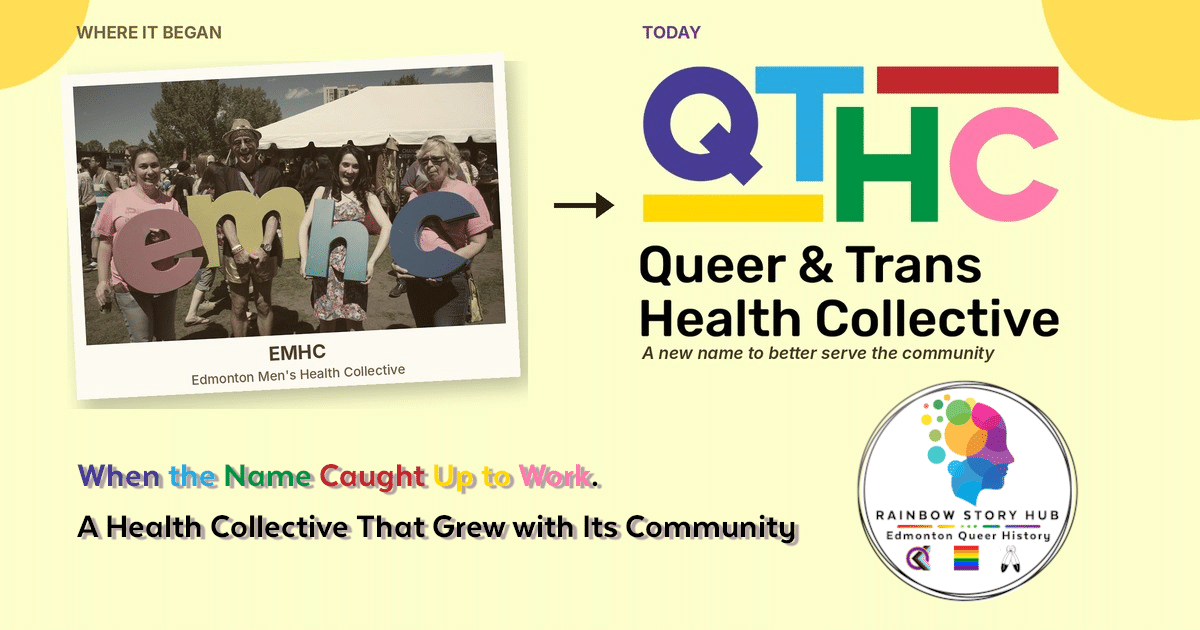
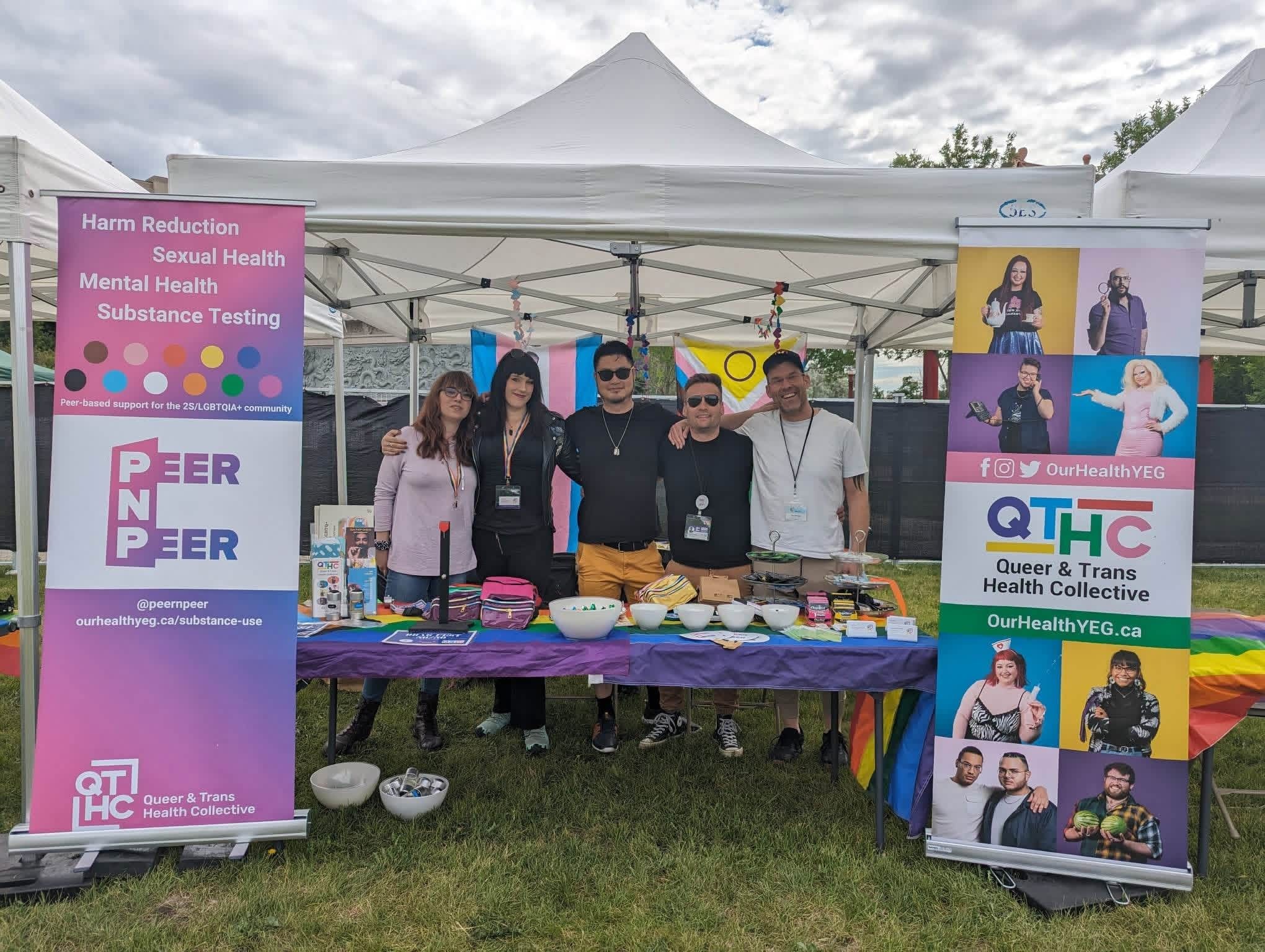
Today it’s the Queer & Trans Health Collective (QTHC), but for years the organization was called the Edmonton Men’s Health Collective (EMHC). Ask QC Gu, QTHC’s Education and Advocacy Manager, and the old name only told part of the story.
“It was always more than just cis men”, QC says. The people showing up included trans men alongside gay and bi cis men from the beginning. So, the 2021 name change was more a rectification than a turning point. The work had moved on long before the letterhead did.
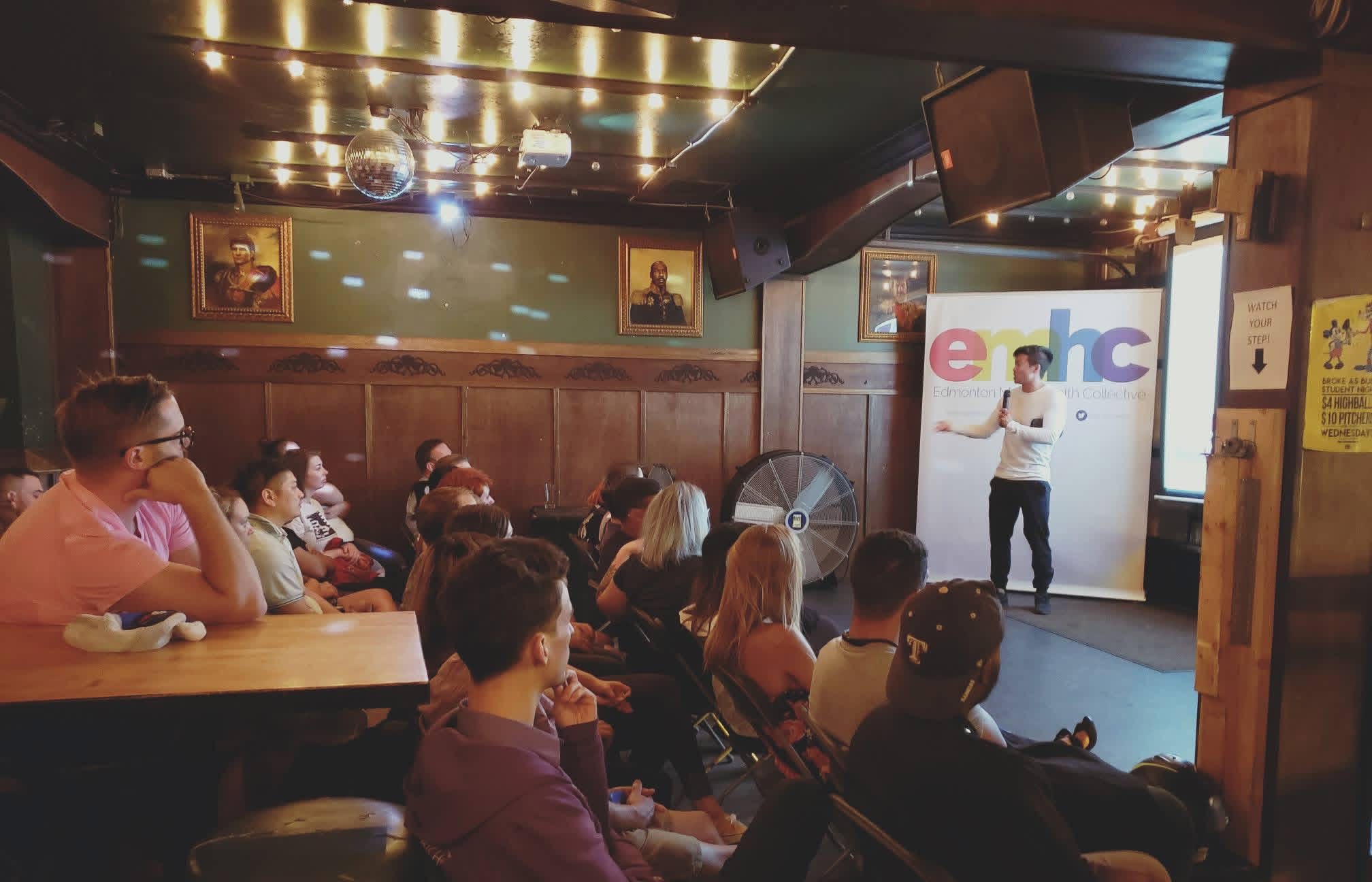
QC marks the start of the QTHC within a longer lineage of community-run health work that reaches back to grassroots activism during the AIDS epidemic. Brook Biggin, who had worked at HIV Edmonton as a Community Education Facilitator, began what became EMHC. Envisaging began in July 2015 at a first meeting in the living room of a shared house Brook and his roommates called the Queer Castle, where about a dozen people came- a “ragtag group”, as he remembers it. EMHC formally launched in April 2016 as an effort to fill gaps in health services for gay, bi, queer, and trans men in Edmonton.
But from early on, the work reached beyond its founding scope. QC recalls conversations with colleagues about centering trans people, both on staff and in the programs. Many initiatives that grew out of those discussions focused on improving trans health, which soon became a core pillar of the organization.
As board, staff, and participant demographics were shifting, it became clear that the programs were valuable to the wider queer and trans community in Edmonton and the area. The organization reworked its vision and mission to reflect everyone it served. The name was the last thing to change.
Toward the end of 2020, the organization began consulting the community and stakeholders about what to call itself. For QC, the date matters less than what it meant. They say, “in practice, the change had already been made”; the name was simply behind. In 2021, EMHC became QTHC.
QTHC’s work today: By Community, For Community
QC notes that the Affirming Care Alberta Project reflects QTHC’s expanded focus in practice, aiming to make affirming care the provincial standard for trans and gender-diverse people. QTHC is working directly with the professional associations that govern doctors, nurses, and pharmacists, backed by the largest Women and Gender Equality Canada (WAGE) grant ever awarded to a 2SLGBTQIA+ organization.
Closer to the ground, support comes in everyday forms. Peer N Peer is a peer-led program that meets people where they are with substance use and sexual health. Spectrum offers free, confidential drug checking and harm reduction education to festivals and events across Alberta. It is the province’s only federally exempt drug checking program.
Community members are also learning to lead the work through the three HEAL programs. Investigaytors teach participants community-based research over seven months to carry out their studies. Pivot guides them through advocacy toward a systems change project of their own. Totally Outright equips trans, queer, and Two Spirit people to become health leaders in their communities.
In practice, these programs mean that community voices shape decisions, and lived experience counts as expertise.
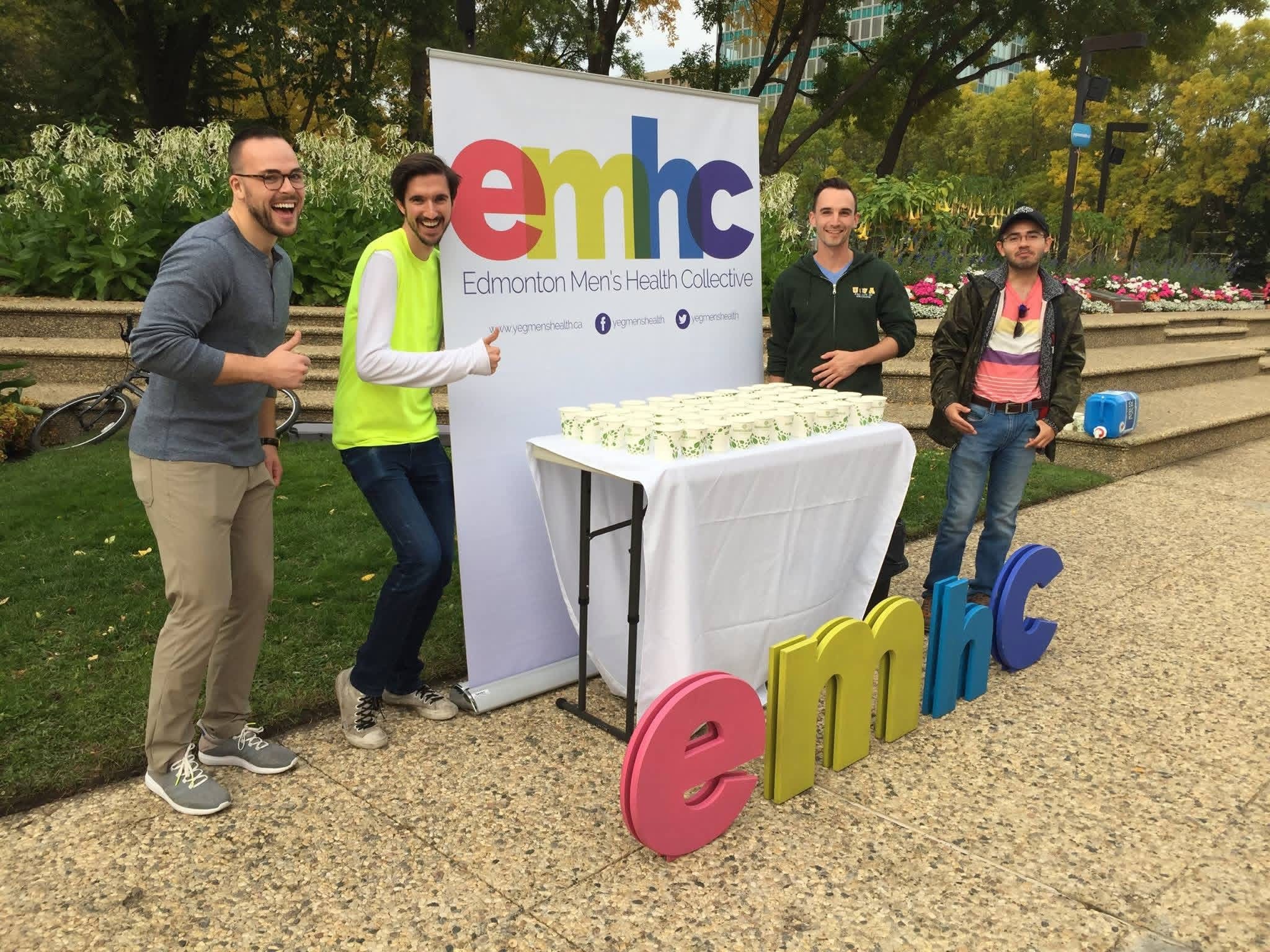
Everyone in the Room
For QC, the pull was the community itself, though they arrived by a roundabout route. They had lost touch with the queer and trans community, and QTHC offered a way back in: “I’d been in the university community for so long that I lost a lot of connections”, they say. Taking the role meant reconnecting.
It’s a small version of a bigger pattern. QTHC grew by letting the community they serve shape what it became. And behind it, as QC reminds us, runs the same thread as ever, back to the people who built care for each other during the AIDS crisis.
QTHC needs your support. Please donate here:
Canada Helps
https://www.canadahelps.org/en/charities/queer-and-trans-health-collective-society/
Zeffy
https://www.zeffy.com/en-CA/organizations/queer-and-trans-health-collective-society
Additional Reading
Website: https://www.ourhealthyeg.ca/
Facebook: https://www.facebook.com/OurHealthYEG
Instagram: https://www.instagram.com/ourhealthyeg/
Edmonton Community Foundation. (2020). Equality in health. Legacy in Action.
https://ecf.ca/legacy-in-action/equality-in-health
Queer & Trans Health Collective. (2021). Queer & Trans Health Collective Report on the Discovery of Our New Name.
https://www.ourhealthyeg.ca/s/QTHCNewNameReport.pdf
Queer & Trans Health Collective. (2025). Queer & Trans Health Collective (QTHC) 2025 – 2028 Strategic Plan.
https://static1.squarespace.com/static/6914cc42d0ecec3c7fefaad0/t/6aa30311ed777934f47c5e7d/1789068049426/QTHC+Strategic+Plan+2025-2028+-+Updated.docx.pdf
Funding for this story made possible by the Edmonton Heritage Council and the City of Edmonton




Ariadna Ramirez-Granados
Ariadna Ramirez-Granados is a public health student and science communicator based in Edmonton, with a background spanning Mexico and Canada. She's passionate about health equity and the community histories behind the systems we build.

 Ruth DyckFehderau
 Cherese Reemaul