


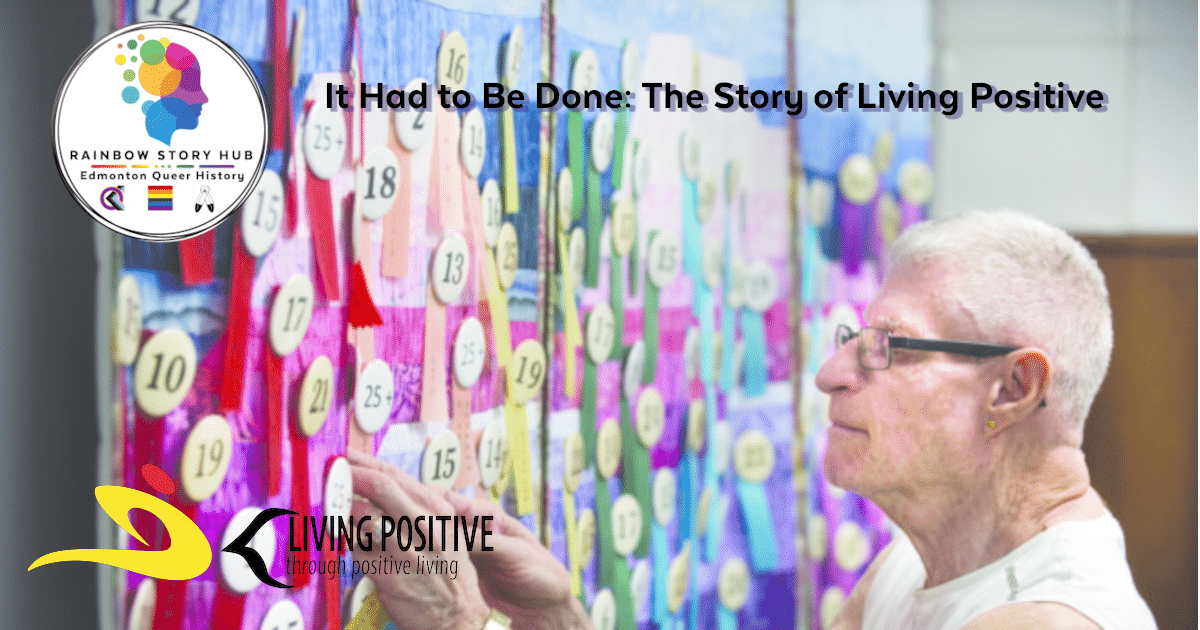
Gil Charest working on the Living Quilt
Courtesy Edmonton Community Foundation
A Note from the Rainbow Story Hub Foundation
This story draws on first-hand memory, the surviving archival record, or both. Some come from one voice, others from several — none is the whole account.
We want to hear yours. You don’t need to have run the organization, or have documents to hand, or know how to write it up — a single clear memory is a contribution, and so is a photograph in a shoebox. The people at the edges of a room often remember what the people at the front of it missed. Tell us your idea at yegqueerhistory.ca/contribute, where you’ll also find our Content Creator Guidelines, and we’ll work with you from there.
It Had To Be Done
When Gil Charest was first diagnosed with HIV, doctors gave him three years to live.
At the time, medicine offered little more than a brutal waiting game. There was only a single treatment available—a punishing regimen that had to be taken strictly every eight hours, day and night, and often left patients feeling sicker than the virus itself. A positive test meant automatic, permanent disability. Across Edmonton, the social calendar of the gay community collapsed into a grim rhythm of hospital visits, bedside vigils, and memorials.
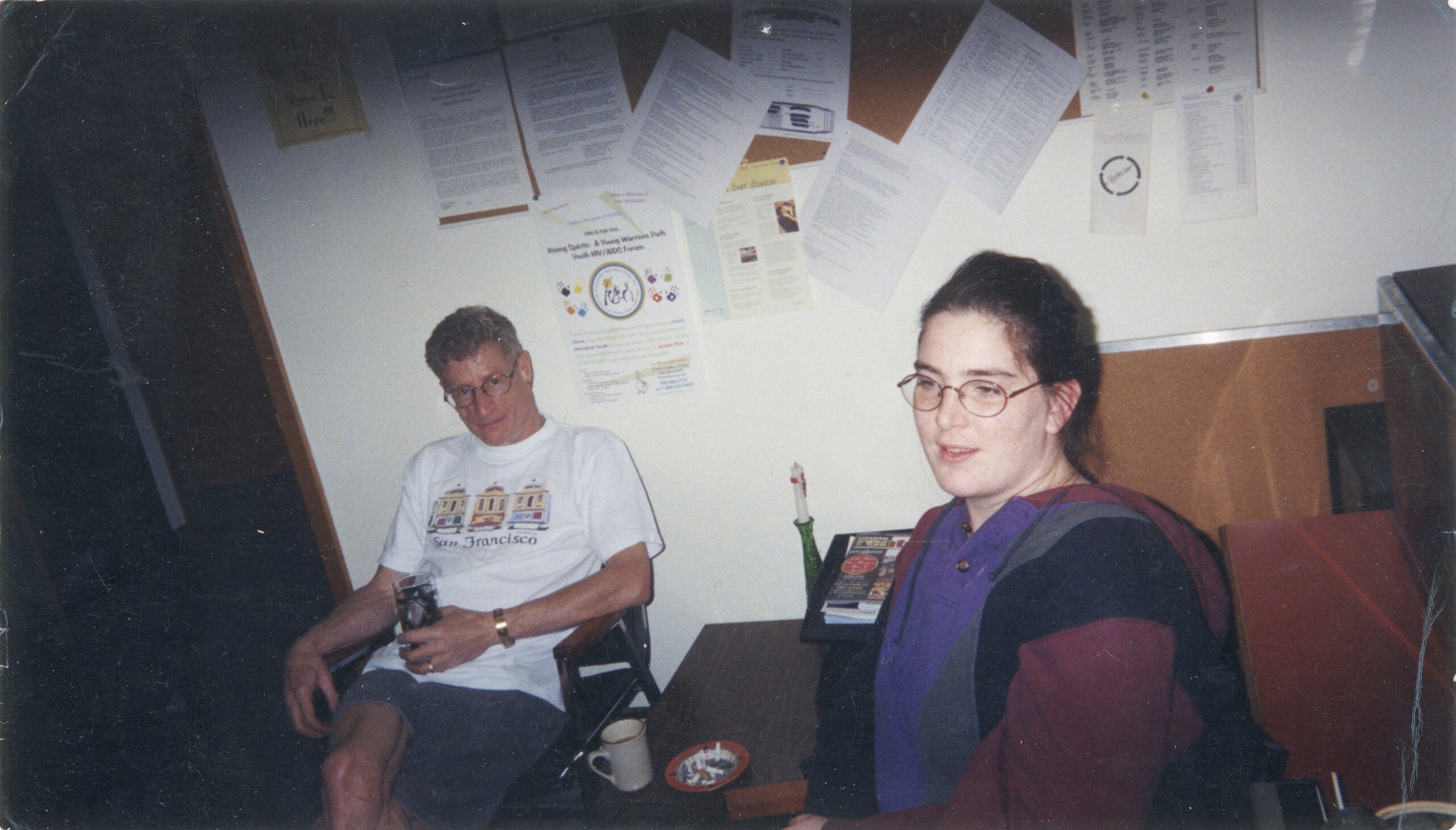
PR2019.0744-104.0038
Gil Charest (L) and unknown person relaxing
[1997-2001]
“I was at the funeral home once or twice a week,” Gil recalls. Volunteering on the dedicated HIV ward at the University of Alberta Hospital, he was confronted daily with the speed of the epidemic. The faces in the beds changed constantly; he rarely saw the same person twice.
Out of that grief and isolation came a simple, urgent conviction: people living with HIV needed each other. They needed a space where they weren’t treated as clinical cases, tragic statistics, or moral cautionary tales, but as whole human beings navigating a terrifying new reality together.
As Gil puts it, looking back decades later, “It had to be done.”
Four Doors, One Mission on Jasper Avenue
In the late 1980s, Edmonton’s grassroots response to the crisis began taking shape inside a shared office space on Jasper Avenue, at 201-11456 Jasper Ave. Behind that single street address sat four independent AIDS service organizations, each stepping up to fill a critical gap in a system that had largely left patients to fend for themselves:
The AIDS Network of Edmonton (which later became HIV Edmonton), founded by Michael Phair, focused on the macro battle: navigating government relations, securing operational grants, and advocating fiercely for access to emerging medications and clinical care.
Feather of Hope provided culturally grounded, holistic support tailored primarily for Indigenous people living with HIV.
The Interfaith Association brought together Anglican, Catholic, Jewish, and other faith leaders to offer spiritual care and funeral rites without the judgment and rejection so many faced from their own congregations.
Living Positive existed for one singular, vital purpose: peer support.
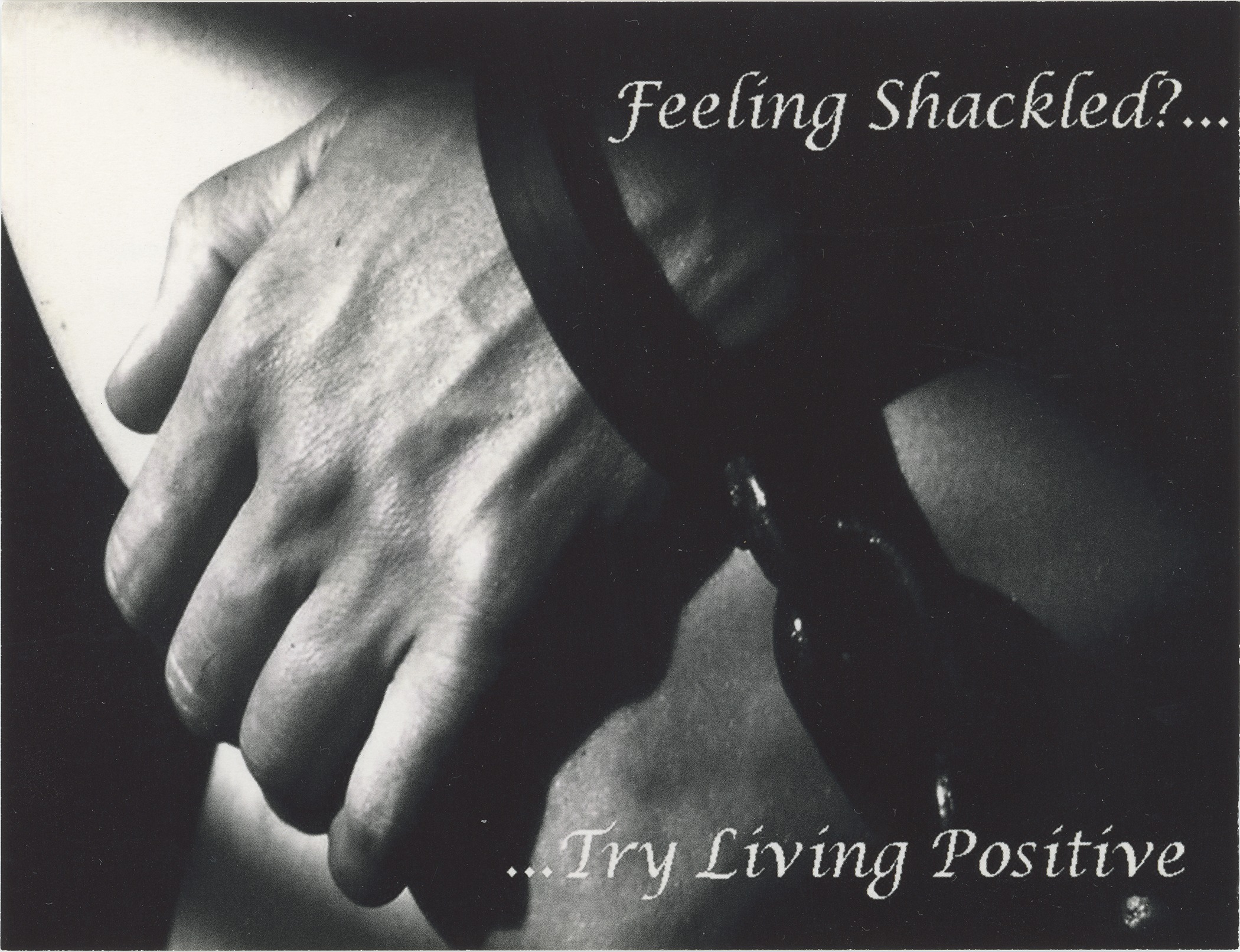
PR2019.0744-81
Feeling Shackled postcard (front)
1990-2011
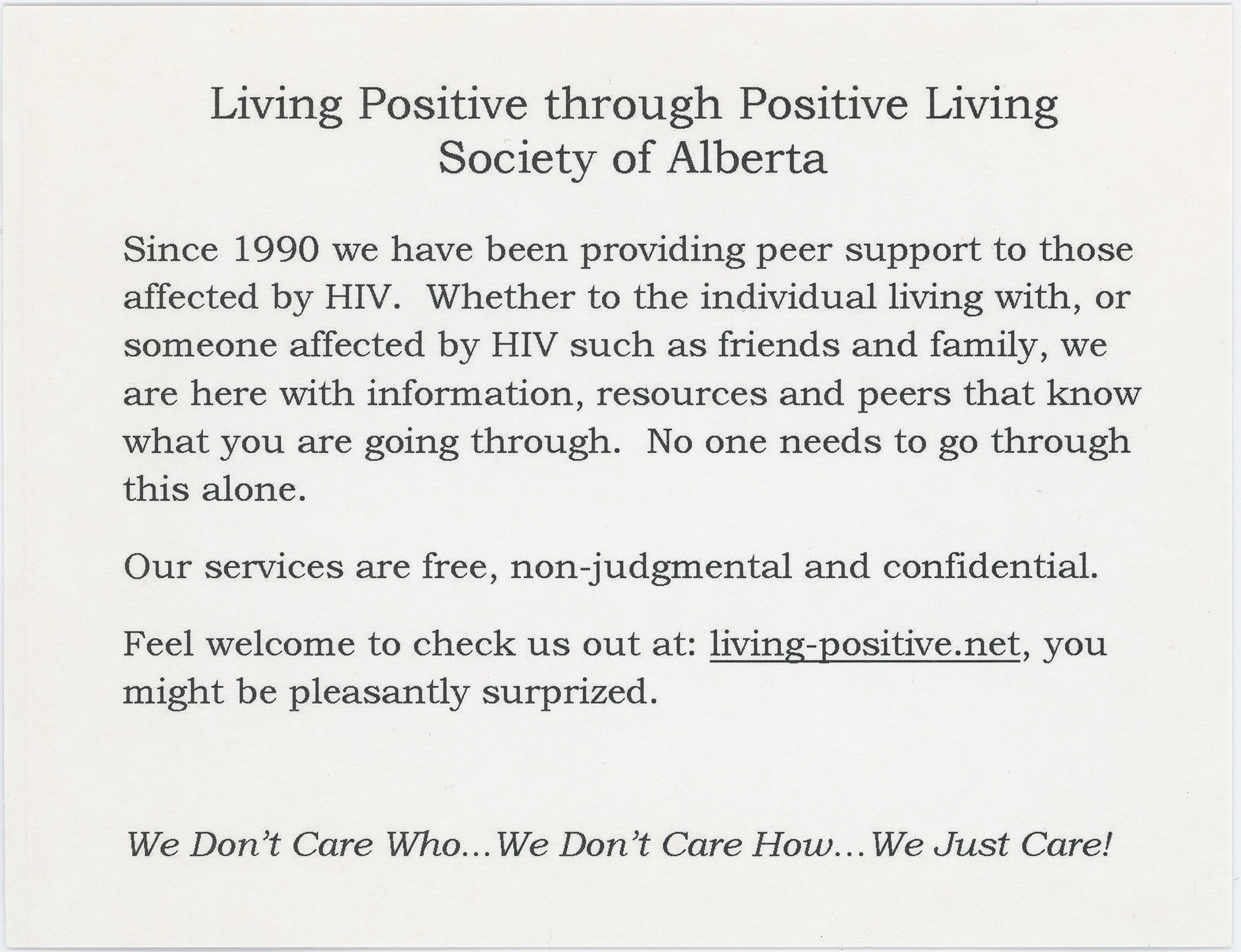
PR2019.0744-81
Feeling Shackled postcard (back),
1990-2011
In the late 1980s, that peer support began inside the AIDS Network of Edmonton as the People With AIDS (PWA) group—later referred to as EPLWHIV (Edmonton People Living With HIV). As the need for an autonomous, peer-led voice grew, participants of the Monday Night Support Group formally incorporated in 1990 as Living Positive: Edmonton Persons Living with HIV Society, registered under the name Living Positive Through Positive Living Society of Alberta. Even in the City of Edmonton Archives today, the original 1988–1990 folder for the support group carries a telling historical turning point written across its cover: “For files after 1990 see Living Positive”.
While it initially formed to support gay men and men who have sex with men (MSM), Living Positive’s doors and mandate broadened over the years to offer peer support, advocacy, public education, and awareness for anyone living with or affected by HIV/AIDS, across all sexual orientations and gender identities.
What set Living Positive apart from every other agency in the building was its governance. While the AIDS Network was staffed largely by social workers, grant writers, and professional advocates, Living Positive was built entirely by and for people living with the virus. Every staff member, every volunteer, and every person sitting on the board of directors was HIV-positive.
“They had the professionals,” Gil says, reflecting on that early division of labour on Jasper Avenue. “What was missing was the lived experience.”
A Lifeline Across the North
For nearly three decades, Living Positive served as a quiet, fiercely protected safe harbour in a city thick with stigma. Every Monday night, members gathered for a peer support group where the heavy armour required to survive outside could finally be set down. Inside that room, nobody had to explain their medication schedule, hide their symptoms, or defend their right to exist.
Alongside its weekly gatherings, Living Positive quickly became an essential independent voice at regional planning tables—working alongside the AIDS Network, Feather of Hope, and the Interfaith Association on major initiatives like the Caring Together Project in the early 1990s to coordinate care and accommodation across the city.
Though headquartered in Edmonton—relocating over the years from Jasper Avenue to 124 Street, then to the old CHED radio building, and finally to 106 Street near the old Red Cross building—its reach stretched across half of Western and Northern Canada. Because Edmonton functioned as the primary medical hub for HIV treatment across Northern Alberta and the Northwest Territories, people flying or driving hundreds of kilometres into the city to see infectious disease specialists regularly made Living Positive their second stop. Even people living in Calgary reached out to the Edmonton office, as no peer-run organization quite like it existed anywhere else in the province.
For hundreds of isolated members living in small towns, rural counties, or remote northern communities, community arrived once a month in the mailbox. Living Positive wrote, printed, and physically mailed out Lifeline, a paper newsletter that was intentionally never converted into a digital publication. For many subscribers who lived completely closeted about their health status—and who didn’t have home internet or couldn’t risk browsing HIV resources on a shared family computer—that envelope was the only reliable medical information, and the only tangible reminder that they weren’t alone, they received all month.
Breaking Stigma, One Conversation at a Time
While the Monday night circle protected members from the outside world, Living Positive’s public education work set out to change that world. Over his years with the society, Gil served as treasurer, president, and one of its most dedicated public speakers, visiting high schools, colleges, and university classrooms across the region to put a human face to the epidemic.
Time and again, he was struck by how deeply misinformation had taken root—even among future healthcare providers. Speaking to university medical students, Gil often realized that the person standing at the front of the room knew vastly more about the realities of living with HIV than the students training to treat it.
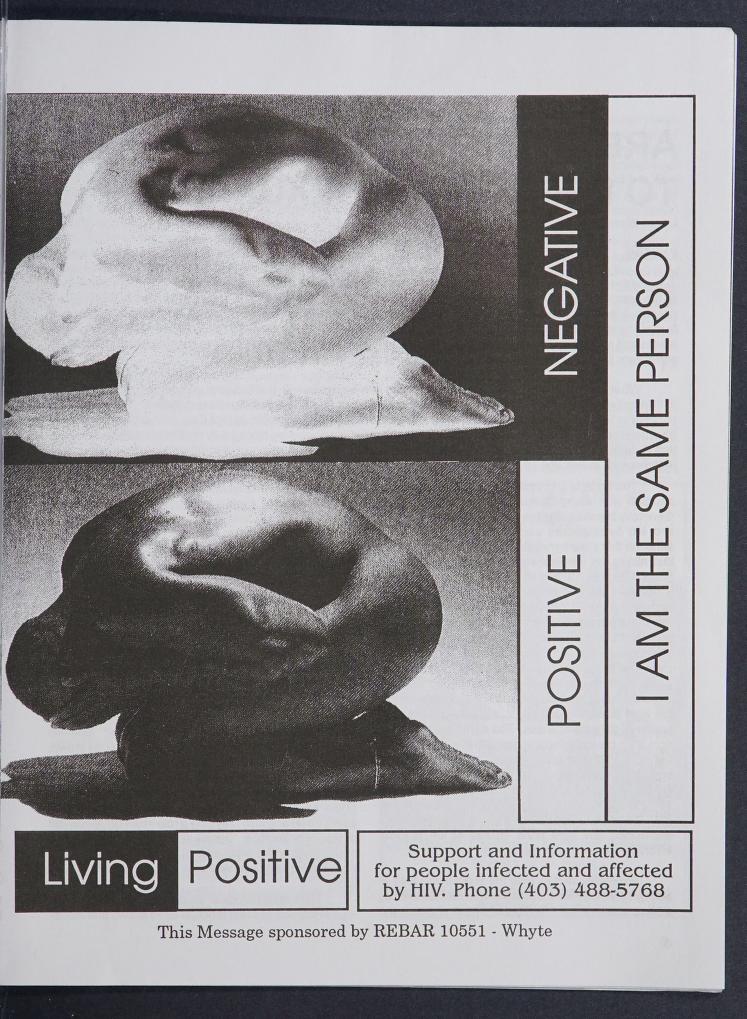
February 1995
While the Monday night circle protected members from the outside world, Living Positive’s public education work set out to change that world. Over his years with the society, Gil served as treasurer, president, and one of its most dedicated public speakers, visiting high schools, colleges, and university classrooms across the region to put a human face to the epidemic.
Time and again, he was struck by how deeply misinformation had taken root—even among future healthcare providers. Speaking to university medical students, Gil often realized that the person standing at the front of the room knew vastly more about the realities of living with HIV than the students training to treat it.
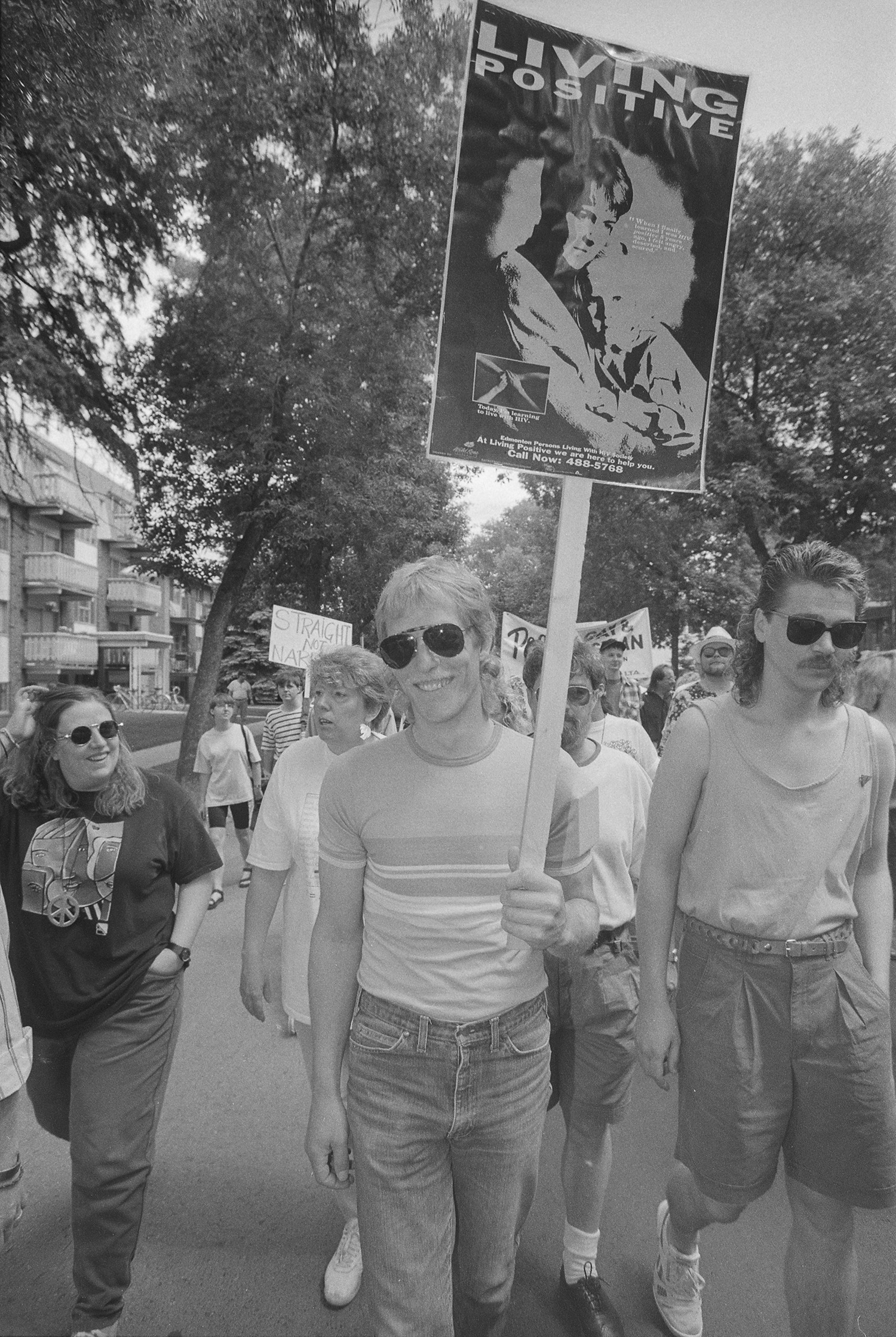
PR2005.0335-1504.0019
Living Positive poster at Pride march carried by Cornie Meyer
1993
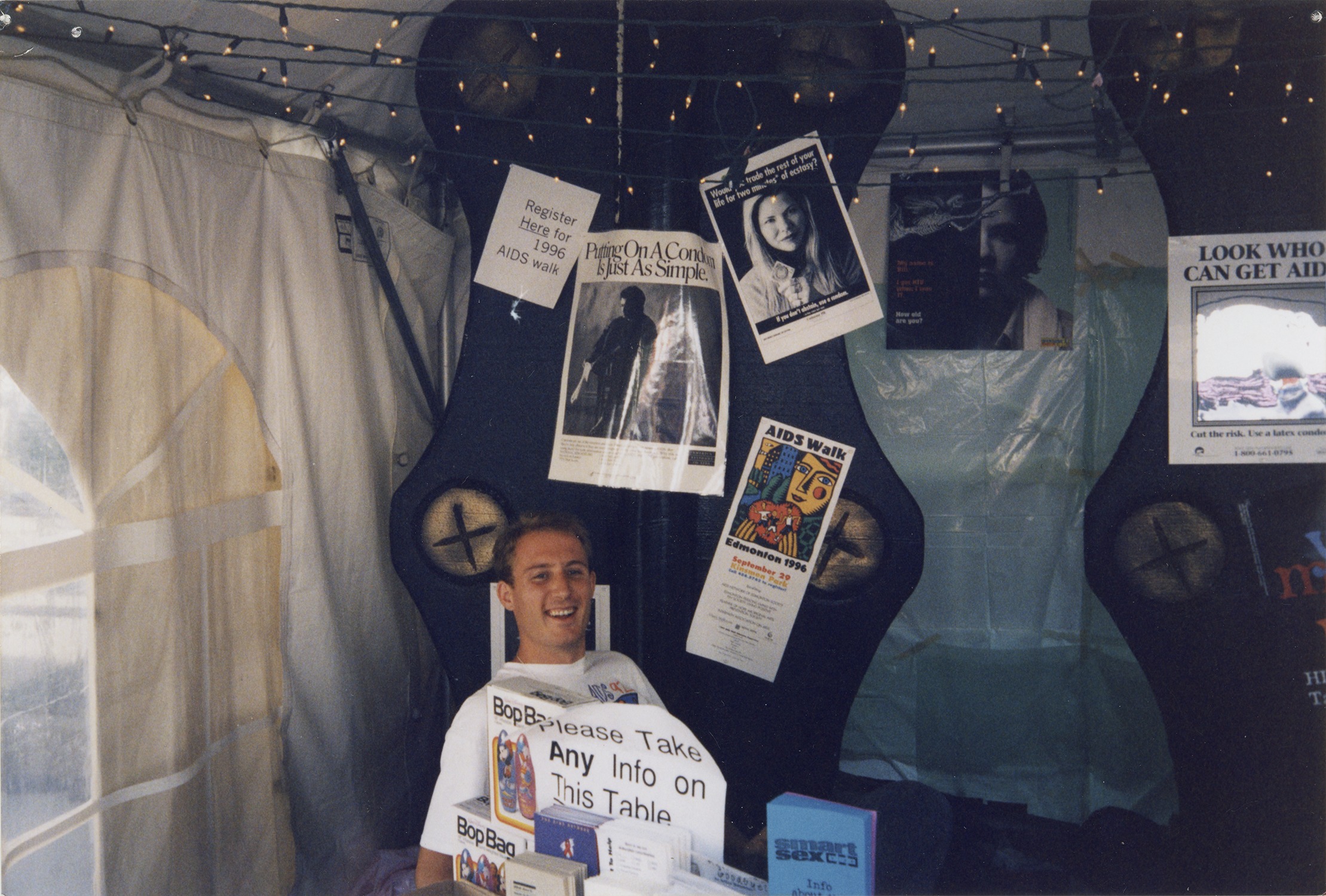
PR2019.0744-104.0003
Information booth
[1997-2001]
Every year around World AIDS Day, Gil poured his energy into what remains his proudest project: coordinating public displays of the Living Quilt across Edmonton. Alongside community partners involved with the Canadian AIDS Memorial Quilt (The Names Project), he arranged for panels of the memorial quilt to be hung in prominent civic spaces—from City Hall and the Citadel Theatre to the Art Gallery of Alberta—forcing the public to confront the scale of the lives lost.
In the late 2010s, Gil arranged for the quilt to hang for a week in the atrium of the Kaye Edmonton Clinic, directly across from the main-floor pharmacy and just two floors below the city’s dedicated HIV clinic. Even then, nearly thirty years into the epidemic, doctors and nurses working inside that very building would stop in front of the fabric panels to ask Gil basic questions about transmission and care.
“It would blow me away,” Gil says, still amazed by how much stigma and misunderstanding persisted inside the medical system itself.
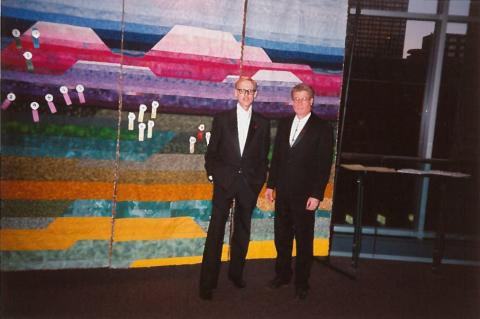
This was the first time the quilt was displayed.
Courtesy Royal Alberta Museum
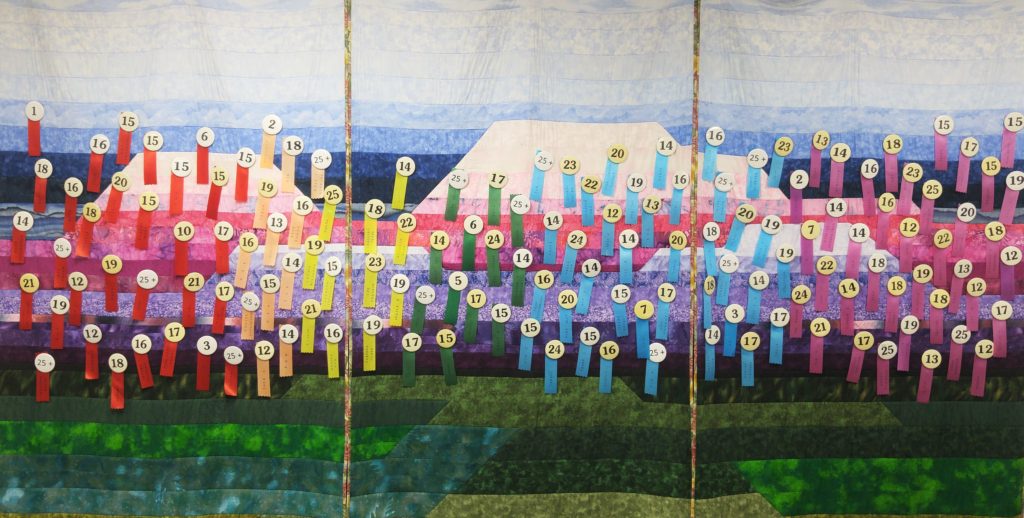
Courtesy Gil Charest/Facebook
A Changing World and a Conscious Goodbye
By 2019, the landscape surrounding HIV—and the way human beings connected with one another—had shifted beyond recognition.
Advances in antiretroviral therapy had transformed HIV from a terminal diagnosis into a manageable chronic condition. People were living full, healthy lifespans, and the acute crisis of weekly funerals had thankfully receded into memory. At the same time, the rise of the internet and social media had fundamentally changed how people socialized, sought advice, and built community. Younger generations newly diagnosed with HIV no longer felt the need to walk through a physical office door or sit in a circle of folding chairs on a Monday night to find peers; they were connecting instantly through online forums, apps, and digital networks from their own living rooms.
Living Positive’s entire model, however, was built on the power of in-person gathering—on the irreplaceable warmth of sitting face-to-face with someone who understood. As digital connection replaced physical gathering, the Monday night chairs began to empty, and recruiting a new generation of volunteers to run the office and sit on the board grew increasingly difficult.
On paper, Living Positive could have lingered on for years. The organization still had steady revenue from Alberta’s charitable casino program and money in the bank. But Gil—serving as the society’s final president—and the board refused to let a vital institution slowly hollow out into an empty office with nobody left to turn on the lights.
In 2019, just months before the COVID-19 pandemic would shut down in-person gatherings worldwide, the board made the conscious, dignified decision to wind down operations and close the society’s doors on their own terms.
Preserving the Memory
Closing the office did not mean erasing the story. Determined that the struggles and triumphs of Edmonton’s HIV community wouldn’t vanish into forgotten filing cabinets, Gil spent the early 2020s organizing decades of Living Positive’s historical records, board minutes, photographs, and every single printed issue of Lifeline, donating the collection to the Provincial Archives of Alberta—complementing the early 1988–1994 records preserved in the City of Edmonton Archives—so future generations could read the history in the words of the people who lived it.
He also worked to ensure the organization’s spirit of mutual aid would continue helping Albertans for decades to come. Using the society’s remaining funds, Gil helped establish the Gil Charest Living Quilt Fund through the Edmonton Community Foundation—an endowment he continues to direct today at 80 years old.
Living Positive was born out of raw necessity during a dark time in Edmonton. It lasted because ordinary people refused to let their neighbours suffer alone, proving that even in the face of an epidemic, the strongest medicine isn’t always found in a pharmacy—sometimes, it’s found in a room full of people who truly understand.
We are very grateful for the collaboration of the Private Collections Archivists at the Province of Alberta Archives.
The Living Positive collection is preserved at the PAA and you can click the link below for more information.
Rainbow Story Hub Foundation
Funding for this story made possible by the Edmonton Heritage Council and the City of Edmonton


Additional reading:
Living Positive Through Positive Living Society fonds
Provincial Archives of Alberta
A Patchwork of Life
Edmonton Community Foundation – June 7, 2018
Stories to Tell: Collecting Alberta’s LGBTQ2S+ History
Royal Alberta Museum – October 12, 2021 (updated June 2024)


Cherese Reemaul
Cherese Reemaul is a researcher and writer with the Rainbow Story Hub Foundation, bringing many years of experience delivering and managing frontline social services for high-risk and street-entrenched communities across Canada's non-profit sector. Alongside community storytelling,
Cherese specializes in project management, operational systems, program architecture, and evaluation frameworks—particularly in high-stakes environments with complex legislative frameworks, intricate partnerships, and strong personalities.
Raised in the Caribbean, Cherese now calls Treaty 6 territory in Amiskwaciwâskahikan (Edmonton, AB) home.
- Cherese Reemaul

- Cherese Reemaul

 Rhys Primus
 Ariadna Ramirez-Granados