

A Note from the Rainbow Story Hub Foundation
This story draws on first-hand memory, the surviving archival record, or both. Some come from one voice, others from several — none is the whole account.
We want to hear yours. You don’t need to have run the organization, or have documents to hand, or know how to write it up — a single clear memory is a contribution, and so is a photograph in a shoebox. The people at the edges of a room often remember what the people at the front of it missed. Tell us your idea at yegqueerhistory.ca/contribute, where you’ll also find our Content Creator Guidelines, and we’ll work with you from there.
This story was written with the assistance of personal memories and archival materials shared by Najma Mungai.
Today, Mama Kash served as one of RaricaNow’s longest‑standing board members, her enduring love woven into the fabric of the organization. But the story of how she arrived here — and how her daughter, Queen Kash Bae, became part of RaricaNow’s history — is also the story of how RaricaNow itself grew into a lifeline for queer and trans newcomers across continents.
RaricaNow is a non‑profit organization founded in 2017 with a clear and urgent purpose: to promote human rights for LGBTIQ+ refugees and newcomers in Canada, and to raise awareness about the gaps in services and the struggles faced by this unique population. It emerged because queer and trans newcomers were falling through every crack — immigration systems, social services, housing supports, and community networks. RaricaNow stepped in where no one else did, building a space where safety, dignity, and belonging were not luxuries but expectations.
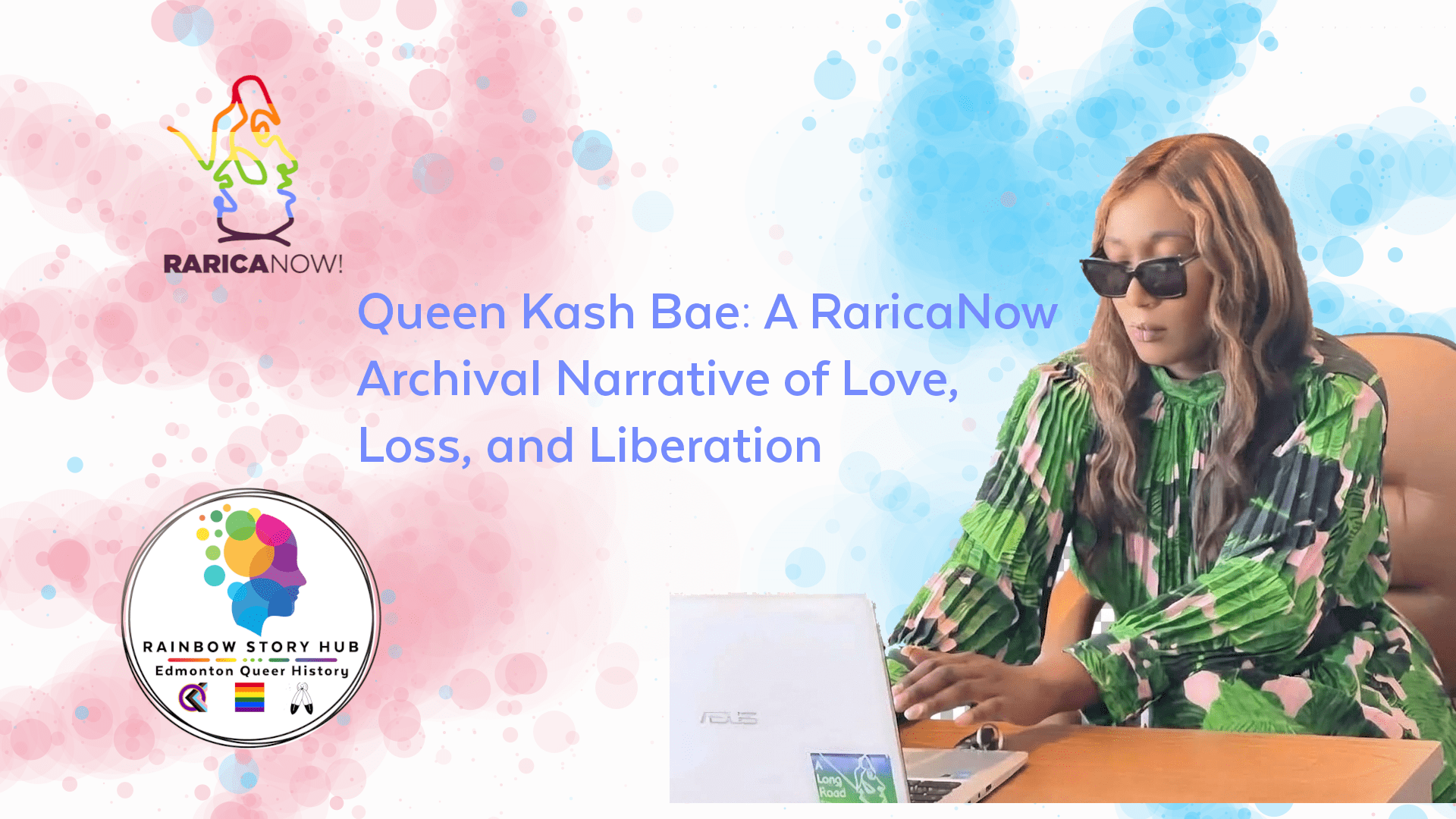
Pictured below: Queen Kash Bae, Executive Director and founding member of RaricaNow hard at work at RaricaNow’s offices in West Edmonton.

The organization began in a small community center, offering support groups, counseling, and educational workshops. Word spread quickly. People who had never before felt seen found a place where they could breathe. As demand grew, RaricaNow expanded into larger spaces, built more programs, and deepened its commitment to trauma‑informed, culturally grounded care. It became a home — not just in Edmonton, but across borders.
Among the many people whose lives intersected with RaricaNow, few stories illustrate the organization’s impact more powerfully than the story of Queen Kash Bae and her mother, Mama Kash.
Where the Story Begins: Kenya
Long before RaricaNow existed, long before Edmonton entered the picture, there was a home in Kenya filled with laughter, chosen family, and the steady presence of Grandma Grace. This is where the story of Queen Kash Bae begins.
Kash grew up as the first grandchild, cherished deeply by her grandmother, who embraced her identity without hesitation. Grandma’s home became a refuge for queer and trans youth who had nowhere else to go. Inside those walls, meals were shared, jokes were exchanged, and young people found the safety denied to them outside.
But beyond the gate, danger was constant. Kenya’s social climate made trans life precarious. Kash faced police raids, community harassment, and escalating threats of violence. At night, she would call her mother, terrified that the community would burn down the house. Still, she remained a protector — fearless, outspoken, and committed to shielding her community.
When Grandma passed in 2014, Kash stayed in the house and continued her work of care. Four months later, her mother — now known as Mama Kash — moved in. Over time, more trans youth joined them. The house became a living archive of queer survival, a place where dozens of young people found food, shelter, and family. Many still live there today.
Kash’s leadership was rooted in love, courage, and the Afrocentric principle of Ubuntu — I am because we are. She protected her people fiercely, even when the world punished her for it.
Leaving Kenya: Searching for Breathable Air
In 2017, Kash left Kenya for the United States. She worked, built community, and tried to create a life free from violence. But she remained tethered to Nairobi, continuing to protect her friends and her mother from afar, with the connections she had on the ground and in the community. Her chosen family relied on her strength, her guidance, and her unwavering commitment.
Still, danger followed her community. And Kash persisted. After 6 months in the United States, Kash came to Edmonton. And became involved with RaricaNow.
February 15, 2022: The Day Everything Changed
It was an ordinary day in Nairobi. The trans community was gathered at home — talking, cooking, laughing, living. Then a phone rang. A friend in Canada was on the line.
The words came slowly, as if the caller was struggling to breathe:
“Kash is no more.”
The world stopped.
Mama Kash ran outside screaming, her voice cracking open the sky. She kept calling her daughter’s phone, desperate for a different answer. Just two days earlier, they had spoken for three hours — laughing, dreaming, planning. Kash had been happy. She had sounded full of life.
Every year, Kash surprised her mother on Valentine’s Day. That year, the surprise never came.
Grief hit like a tidal wave. And instead of compassion, the greater community around her mocked her pain. They laughed. They whispered. They refused to support her because her child was trans. Her mourning became a spectacle.
In that moment, Mama Kash stood alone — surrounded by people, yet utterly abandoned.
This is the reality of many Black trans families: grief becomes public, pain becomes politicized, and dignity becomes something you must fight for even in your darkest hour.
February 17: The Call From Edmonton
Two days later, another call came. This time, it was Kash’s community in Edmonton — her friends, her chosen family, and RaricaNow.
Their voices were soft, trembling with their own grief:
“Do you want to return the body to Kenya? What can we do to support?”
This call was different. It carried care. It carried responsibility. It carried love.
RaricaNow mobilized immediately.
For the first time in her life, Mama Kash boarded a plane. It was not a journey of excitement — it was a journey of heartbreak. She arrived in Edmonton, where RaricaNow met her at the airport, held her through the shock, and handled every detail of the burial.
It was here that Mama Kash learnt that her daughter, Queen Kash Bae was the Executive Director and a founding member of RaricaNow.
Pictured below: a memorial presentation in memory of Queen Kash Bae at Edmonton Pride Festival in August 2025.
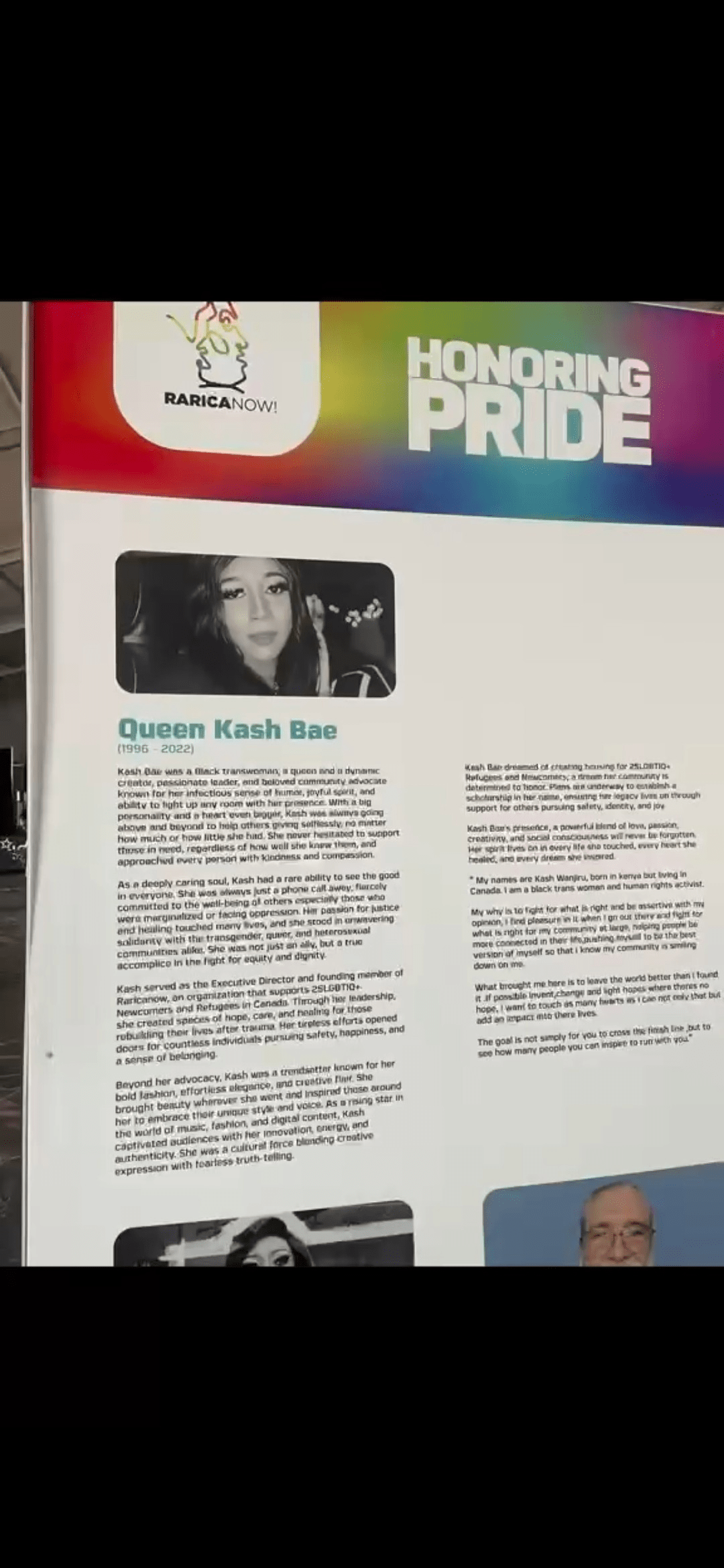
On May 7, 2022, Queen Kash Bae was laid to rest at St. Michael’s Cemetery in Edmonton
The burial was not just a ceremony — it was a collective act of love, a community refusing to let a Black trans woman’s life be erased.
Danger Back Home: The Violence of Grief
As news of Kash’s death spread through Nairobi, the danger against the community intensified. Without Kash’s protection and on the ground connections, the threats escalated.
People said openly:
“We will kill her.”
Mama Kash’s marriage ended. Her daughter’s father wrote:
“I don’t want to see you or your mother. I will start killing you because you are my blood.”
Canada’s immigration officials investigated on the ground. The village confirmed the threats:
“She brings all the gays here. We will kill her.”
This was not metaphor. It was not exaggeration. It was the lived reality of a Black trans family in a hostile environment.
It was even more unsafe than before.
RaricaNow continued to offer care, connection, and community support — quietly, consistently, lovingly.
This is what Afrocentric queer care looks like: showing up when systems cannot, holding people through danger, and refusing to let anyone fall through the cracks.
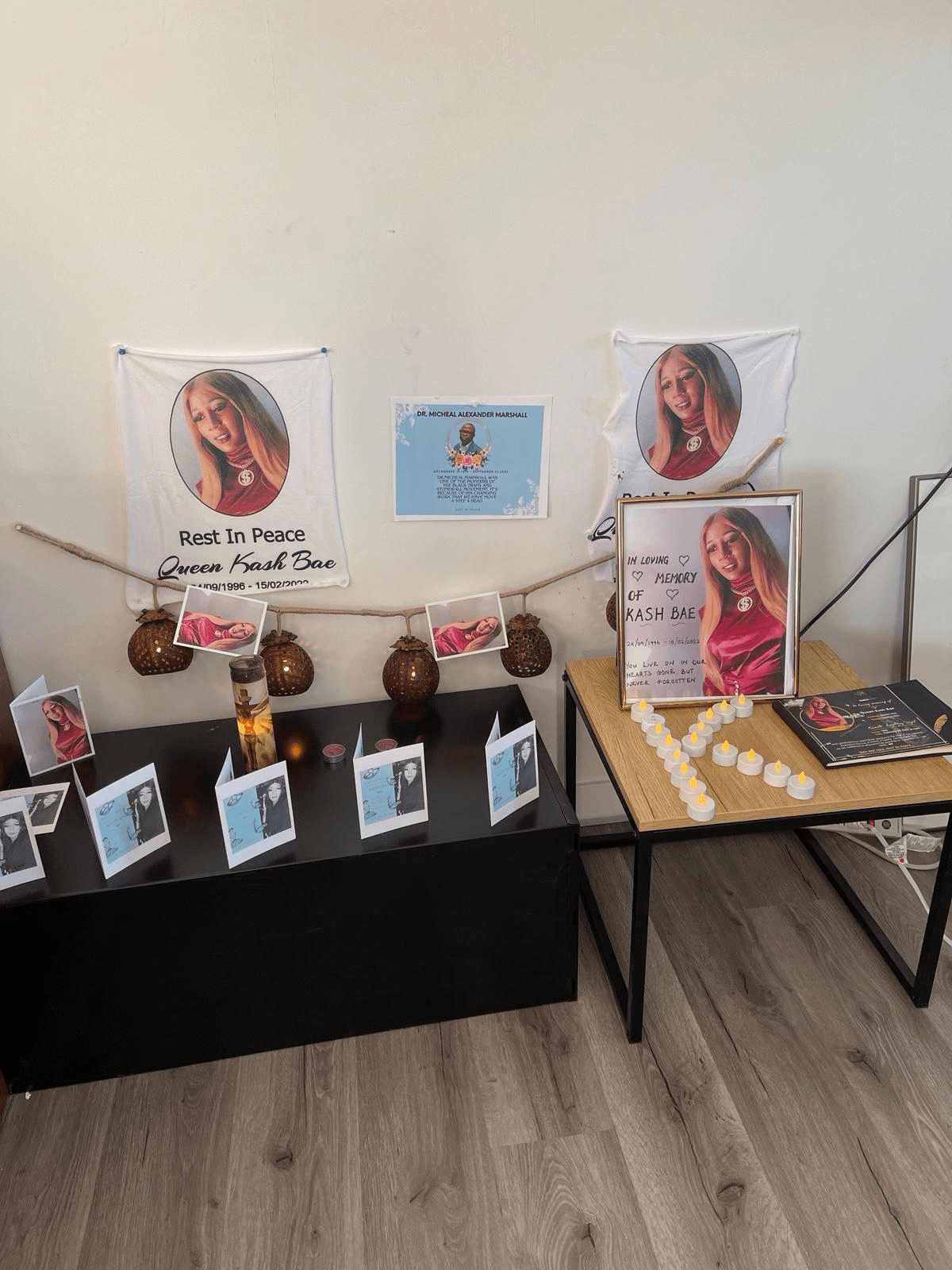
Pictured below: a memorial for Queen Kash Bae in place at RaricaNow’s offices in West Edmonton.
Becoming Part of RaricaNow: A Mother to Many
In November 2022, RaricaNow invited Mama Kash to their Trans Day of Remembrance (TDOR) event. They checked in:
“Are you okay? Do you have food? Are you safe?”
These questions were not procedural — they were ancestral. They echoed the traditions of Black kinship, where care is not charity but obligation, where community is not optional but sacred.
After TDOR, RaricaNow put out a call for board members.
Mama Kash said:
“All I have is the skill to love. To be a mother.”
And RaricaNow said:
That is enough.
Many Black trans people have no mother, no family, no one to call home. Mama Kash became that home. She showed up to every event. She offered love, warmth, and presence. She became a cultural anchor — a reminder that Black trans people deserve family, deserve tenderness, deserve someone who will fight for them.
People began calling her Mama Kash.
She says:
“It fills my heart. When someone calls you ‘Mama,’ it means they see the mother in you. Sharing is part of my healing. When I share, I become strong.”
Her presence became a cornerstone of RaricaNow’s community work. She offered what systems could not: unconditional love, cultural grounding, and the wisdom of someone who had survived unimaginable loss.
Legacy: What Queen Kash Bae Left Behind
Kash left behind a community in Kenya — a house full of trans youth who still live together today, in that house, right now. She left behind a mother who carries her legacy with grace and courage. She left behind a global network of Black trans people whose lives she touched, including RaricaNow, an organization that stepped in when no one else would.
Through trauma‑informed, culturally grounded, Afrocentric care, RaricaNow helped transform grief into belonging, danger into safety, and isolation into community.
Kash’s story is not only about loss.
It is about love, resilience, and the power of Black trans community to hold one another through the unimaginable.
It is about how RaricaNow changes lives — not just in Edmonton, but across continents.
It is about how one trans woman from Kenya became a pillar of strength, and how her mother became a mother to many.
It is about legacy.
It is about liberation.
It is about RaricaNow, and the community it continues to build — one story, one life, one act of love at a time.
Additional Reading:
RaricaNow
Website: https://www.raricanow.ca/
Facebook: https://www.facebook.com/RARICAnow/
YouTube: https://www.youtube.com/@raricanow843
EWAKA Housing Project
https://ewaka-2slgbtiq-refugees-and-newcomers-housing.raiselysite.com/
🌈✨ Honoring the Life and Legacy of Queen Kash Bae ✨🌈
Instagram – @RaricaNow
Reflecting on the Legacy of Black Trans Voices
RaricaNow website
Funding for this story made possible by the Edmonton Heritage Council and the City of Edmonton



Cherese Reemaul
Cherese Reemaul is a researcher and writer with the Rainbow Story Hub Foundation, bringing years of experience in community-based social services to the work of documenting Edmonton's 2SLGBTQ+ history. Raised in the Caribbean, Cherese came to Canada as an adult and has since built a life and career across Western Canada, living in Vancouver and Saskatoon before settling in Edmonton.
Cherese holds a Bachelor of Education and an MBA earned in Australia. In British Columbia, they spent years as a project manager developing and evaluating programs for vulnerable people and served on the board of the Pacific Immigrant Resources Society. In Saskatoon, they managed housing and support services at OutSaskatoon, evaluated programs for the Saskatoon Housing Initiatives Partnership, and became Client Care Manager at Global Gathering Place, supporting refugees and newcomers. In 2021 they ran federally for the Green Party in Carlton Trail–Eagle Creek.
More recently, as a project lead with the Dr. Peter Centre, Cherese helped guide The Canoe Project, a national initiative advancing Indigenous-led harm reduction. Across every role, Cherese's work centres dignity, connection, and community-led change.
- Cherese Reemaul
 Rhys Primus
 Ariadna Ramirez-Granados