
A Note from the Rainbow Story Hub Foundation
This story draws on first-hand memory, the surviving archival record, or both. Some come from one voice, others from several — none is the whole account.
We want to hear yours. You don’t need to have run the organization, or have documents to hand, or know how to write it up — a single clear memory is a contribution, and so is a photograph in a shoebox. The people at the edges of a room often remember what the people at the front of it missed. Tell us your idea at yegqueerhistory.ca/contribute, where you’ll also find our Content Creator Guidelines, and we’ll work with you from there.
Even if you go looking, you won’t find many photos of altView’s early days. The founders and all the participants were youth and you didn’t want to take photos of youth because you were never sure who was closeted. In fact, altView had a first-name-only practice so that if attendees were asked if Person X was part of the group, they could plausibly say “I don’t know.”
It all started in 2007 when Bryan Mortensen and Helen Quevillon were at the Edmonton Saturday queer youth peer-support group, Youth Understanding Youth (YUY), facing yet again the question that kept coming up: a significant percentage of Edmonton YUY participants were actually from Sherwood Park. Why didn’t Strathcona County have something for local queer youth? So that youth who weren’t out to their parents wouldn’t have to explain why they wanted to go to Edmonton on a Saturday night?
At some point, the youth stopped talking about it and just began to build the organization they needed. Bryan did most of the initial coordination and planning, and, within a couple of months, Franki Winters joined him to become a main organizer and driving force. Instinctively, they knew what they needed it to be, but they were all youth with little organizational experience. And if the organization would stand up to scrutiny, if anyone was going to feel comfortable referring their queer kids, or if the organization were to be taken seriously at all, they would have to borrow adult standing from somewhere.
Their organization would need infrastructure, so the first thing the youth did was ask a YUY facilitator for the YUY infrastructure manual. They combed it and took what they could. For workable optics, they needed at least to look like there was adult supervision – so they approached a few trusted adults to be facilitators of an organization that would actually be run by the youth (adults who ended up doing a lot of work). For meeting space, Next Step Sherwood Park high school offered one specific bi-weekly timeslot for free. They took it. They needed a name and landed first on “the altView group,” and eventually on altView Foundation for Gender Variant and Sexual Minorities. “altView,” they thought, could simultaneously reference “Alternative View” (to provide a safe environment for everyone, including those who didn’t fit into heteronormative Alberta) and “Alter Views” (to nod to their educational goals of helping heteronormative communities resist systemic exclusion of queers). It was a start.
Bryan mentioned the altView project to someone at Strathcona County Family Community Services. The word got out. Within days people were contacting him. A queer United Church minister couple looking for volunteer opportunities. (They eventually became main supporters and facilitators.) The Sexual Assault Centre at the Sherwood Park Saffron Centre wanting to share their space. And so on.
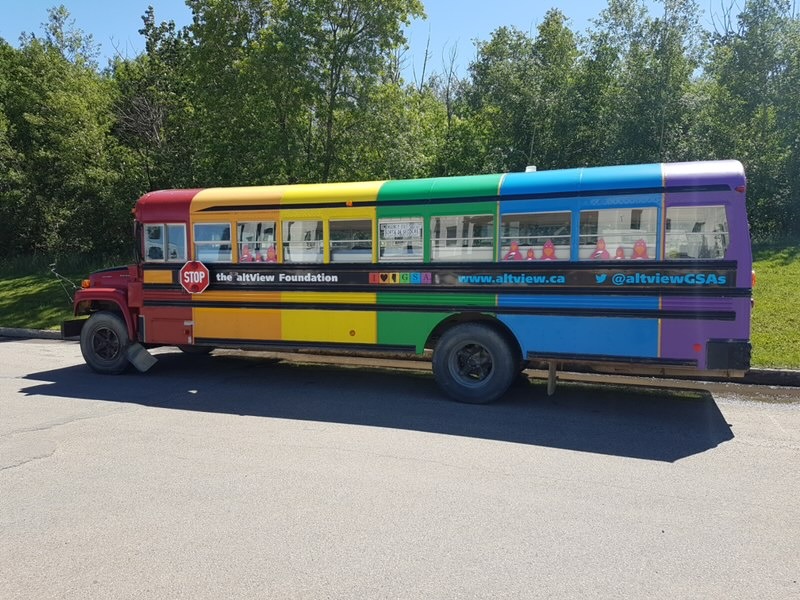
Courtesy Bryan Mortensen
altView launched in February 2008, originally operating just as a group and meeting every other Tuesday evening at 6:30 PM, and in under a year the group began meeting weekly. They opened each gathering with an icebreaker question and moved into an activity. Over the years, they watched movies, learned to knit and crochet, had planning nights and Lego nights and game nights, wrote stories and made art, brought in guest speakers, picked random Ted talks to watch, made buttons, planned (but didn’t make) a printed toilet-paper “smear” campaign against ill-behaved politicians, had scavenger hunts at Ikea, painted an old donated school bus in rainbow stripes for Pride parades, invented a Twilight-candy game (they watched Twilight movies and ate candy whenever a character was creepy – but had to stop because youth felt ill from so much sugar), discussed religion or politics, and had so many potlucks. Afterwards, they headed out for coffee.
Increasingly, gatekeepers were asking policy questions, so the altView founders figured the time had come to build real policy. And that led to intense discussions around adult facilitators needing criminal record checks to work with youth. Queers have a long history of being discriminated against in ways that give them criminal records. For being involved in a protest, for instance, or for “soliciting” after being turfed from their homes by homophobic parents. In the end, altView decided to require criminal record checks but to clarify that certain marks on the record wouldn’t count against facilitators.
Their numbers grew, and altView reached out further. They organized dances and formals and high teas. They put on elaborate fundraisers. They had Saturday evening academic discussions and activities (for instance, making a still-available queer version of Cards Against Humanity) to give people in their twenties something to do that didn’t involve bars or nightclubs. And, over the years, they arranged three full-sized conferences and four micro-conferences.
They were going to need money. When the youth went to apply for grants, they learned that eligibility was tied to becoming a not-for-profit organization. They adapted, put together a board, became a not-for-profit, and landed their first small grant. (The application process had been homophobic though, so one of the altView founders facilitated change in the granting organization.) Becoming a charity would make them eligible for platforms like Volunteer Connector and Canada Helps, and qualify them for even bigger grants. But it meant more infrastructure. They adapted again, and became a registered charity.
Each of these transitions was uncomfortable, time-consuming, deeply stressful – and utterly necessary if altView was going to have community endorsement. Many times, the organization survived only because of the mutual desire to make it work and a real understanding that these changes were necessary. That a group of close friends was running an organization could be a powder keg – and also a genuine advantage.
Around 2013, numbers at the Tuesday evening gatherings began to dwindle. Youth were already finding queer support in Gay-Straight Alliances (GSAs) in their Alberta schools. At the same time, rural Alberta youth were really struggling to build their GSAs and needed support. And with funding increasingly tied to GSA-type projects, the altView founders were thinking that the organization would probably have to adapt again. And just then, a GSA-supporting MLA stated, in the Legislature, that altView was a valuable GSA resource. The mention was entirely unexpected – and made adaptation urgent. With no notice, the team gathered in a borrowed University of Alberta classroom, and, in one evening, developed an entire program, policies, website update, and press release. By morning, it was all in place. altView had adapted again.
For the next five years or so, altView had paid staff who worked as community liaisons, looking for where rural queer youth needed support and trying to provide it. altView helped youth build GSAs, supported existing GSAs (or other queer youth-run organizations), and connected queer resources to rural schools. They worked with school administrations, with parents and caregivers, with teachers’ associations, with the intensely (and surprisingly) supportive Catholic School Board superintendent, with school boards, with individual teachers doing presentations in high school Community and Life Management classes and organizing drop-in peer support services. They convinced suspicious adults that the “alliance” part of “Gay-Straight Alliance” meant that students were safely supporting one another (and did not mean that adult queers were recruiting youth into an “alliance” that planned to resist and dismantle Christian organizations). They raised rainbow flags. They worked with dozens of rural GSAs and spanned an area as far south as Lethbridge and as far north as Fort Mackay. Usually, conversations with reluctant school administrators could be started by discussing statistics on queer youth suicide and establishing a common belief that a dead youth – queer or not — was a bad thing. altView tried to show up wherever they were needed and wanted.
It almost always worked well – though homophobia was everywhere and transphobia was noticeably increasing. And the altView founders were realizing, with great discomfort, that they had left some queer youth behind. Those who didn’t fit into schools at all, or who were homeschooled, or who had certain disabilities. altView was too white, too able-ist, and hadn’t put enough work into trans-inclusiveness. They adapted again and began re-working their infrastructure.
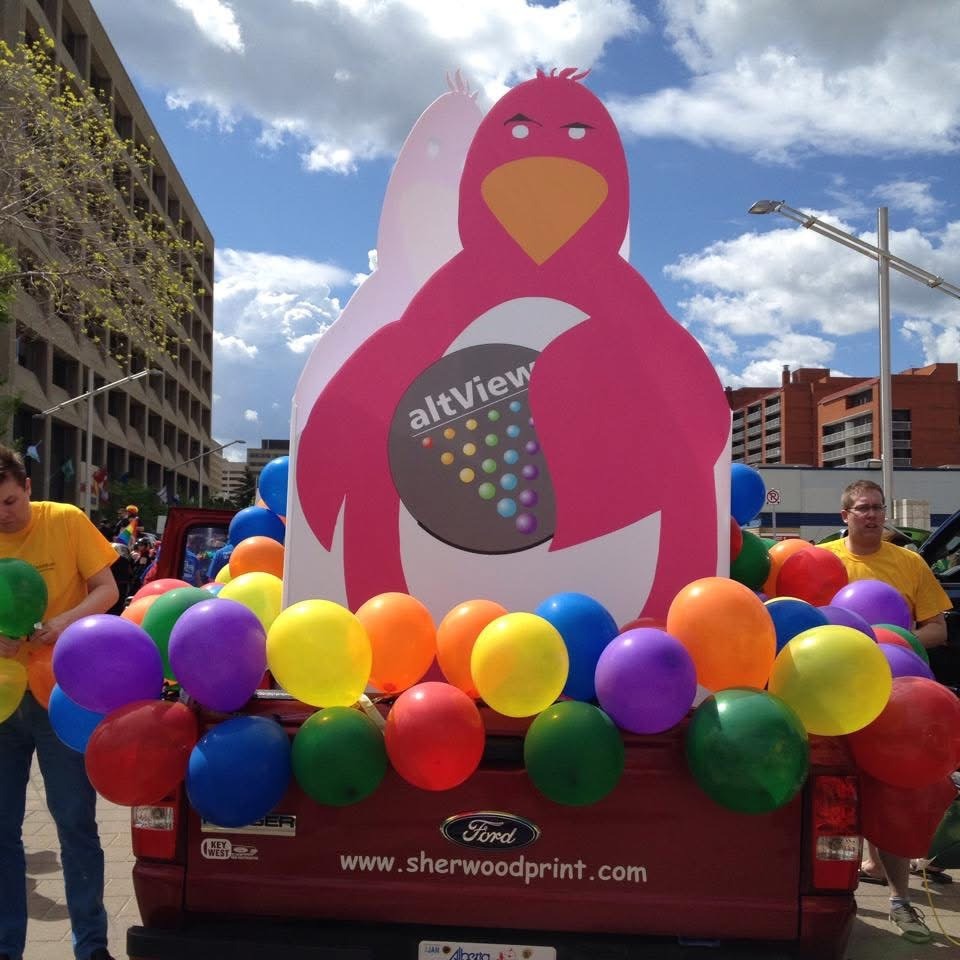
Courtesy Bryan Mortensen
And right around that time, in 2019, the United Conservative Party cancelled the Family Community Safety Program which had provided the backbone of their funding. altView, along with many other queer organizations, started to struggle. The Executive Director at the time volunteered to take a pay cut rather than laying off the front-line staff, and they began to look elsewhere for funds. But in the face of increasing Alberta conservatism, queer funds were decreasing everywhere, and the frustrations were birthing infighting and ugly moments in the Alberta queer communities, just as the world was going into COVID lockdown.
Over the years, altView had accomplished so much more than the 2007 youth had ever set out to do. Their organization had had many presidents – Bryan Mortensen, Franki Winters, Pat Dunn, Ryan Dexter, Stephanie Daly, Elise Johnson, and Sylvia Trenka. And they had met in all kinds of spaces, from highschool basements to church basements to community centre basements and more. Was their time coming to an end?
And so it was that altView had a few very quiet years while one person, Stephanie Daly, tried – by force of will and with a very small board of three or four – to hold it together. It was, she reasoned, a phoenix time of dormancy.
In 2023, all things altView began again to stir. First they met online as a small group. A few months later, they switched to in-person meetings – and as soon as they were around the same table, they felt that old activist energy. Everyone there knew the fear of coming out and then being cut off, the fear of loneliness and disconnection that is part of being queer in a heteronormative province – and they knew how to address it.
With a bit more momentum behind them now, they discussed ever-changing Alberta. The needs had shifted. Youth now had many more resources available to them than they’d had fifteen years earlier, thanks in part to altView, but other demographics really needed social support. And for long-term survival, it would be worth their while to consider carefully, thoughtfully, how best to be a sustainable organization.
Even with numbers so small, altView began to adapt, again. They rebuilt their network with other agencies in and around Edmonton, they rewrote their bylaws, they did strategic planning, they imagined and created new and different programs. To raise funds and to reconnect to the local queer community, they hosted a Drag Revue and participated in a drag bingo. It was a fantastic amount of work.

Courtesy Instagram/ @thealtviewfoundation
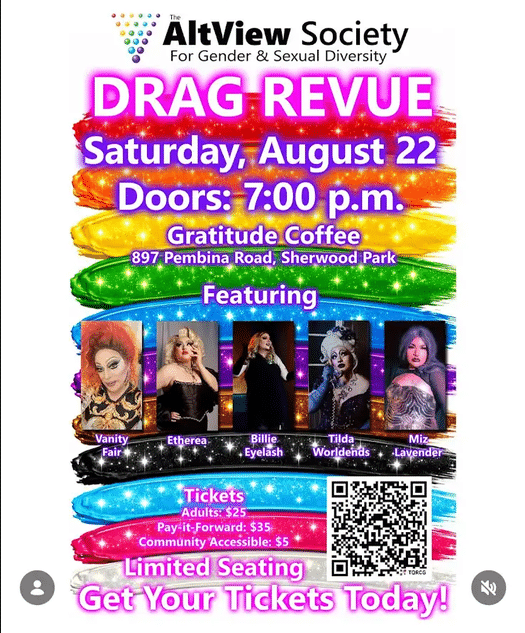
Courtesy Instagram/ @thealtviewfoundation
With newly fashioned infrastructure, back they went to Strathcona County. And the County, gob-smacked to see them, was eager to help. They had never seen a dormant organization reawaken before. They provided support with bookkeeping, with advocacy for council money, with whatever altView needed. Strathcona County wanted altView to thrive again.
And now, in 2026, nearly 20 years after it began, altView is a presence again. Maybe you’ve seen them recently, at a flag raising, or Pride in the Park.
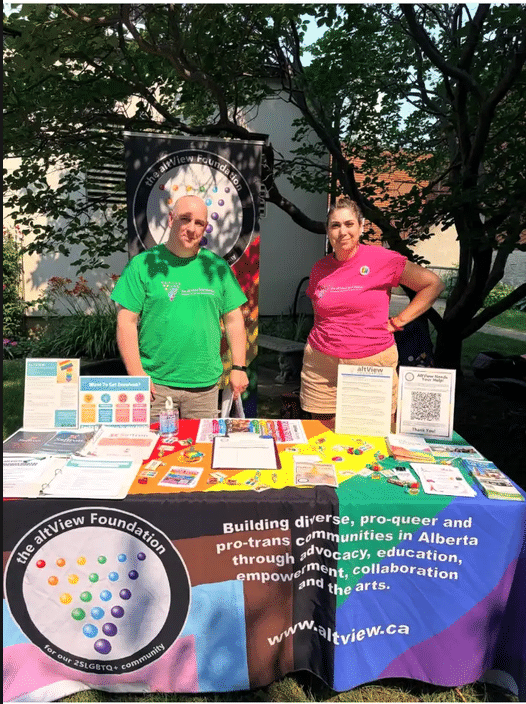
Courtesy Instagram/ @thealtviewfoundation
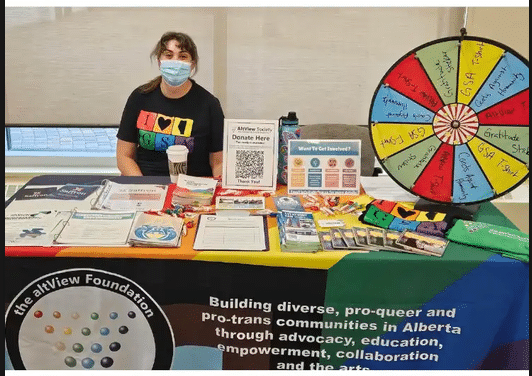
Courtesy Instagram/ @thealtviewfoundation
Under president Dani Greggersen, they continue to build sustainable programming. These days, they meet at 4:30 every second Saturday at Gratitude Coffee in Sherwood Park for an all-ages Coffee and Crafts. And since it’s all-ages, there are more photos.
They’re developing a quarterly speaker series, a writers’ workshop – and as always, they’re paying close attention to where the gaps are, where support is most needed.
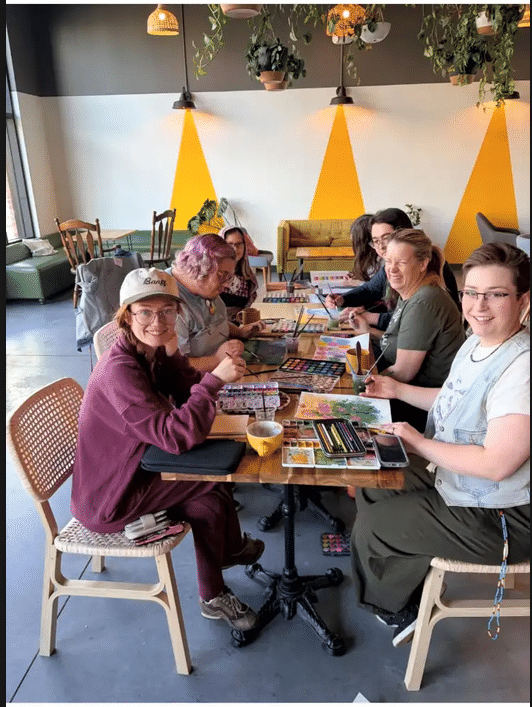
Courtesy Instagram/ @thealtviewfoundation
altView is looking for help! People to think, to imagine, to help with program planning, to support, to hang out, to sit on a board, to teach a craft at the Saturday Coffee and Crafts, to help out and be there in any way at all. If you’re interested, go here.
And be prepared to adapt..
Additional Resources:
Website: https://www.altview.ca/
Instagram: https://www.instagram.com/thealtviewfoundation
Facebook: https://www.facebook.com/altview
X (Twitter): https://x.com/altViewGroup
The Alberta Civil Liberties Research Centre – altView Foundation
https://www.aclrc.com/issues/youth-safe/resources/altview-foundation/
Funding for this story made possible by the Edmonton Heritage Council and the City of Edmonton




Ruth DyckFehderau
Please read our story on Ruth here: https://yegqueerhistory.ca/stories-that-heal-ruth-dyckfehderau/
Photocred to M. Kanjilal
- Ruth DyckFehderau

 Cherese Reemaul